
Hyalophora cecropia; also known as the “Cecropia Moth” or “Robin Moth” is a giant species of moth found in the United States of America and Canada; those who lay their eyes upon this majestic and imposing creature are left with a lasting impression. With a wingspan larger than the average songbird and velvety wings adorned with nearly voodoo-like scarlet, crimson, grey and creamy white markings, this astonishing insect is the apple of the eye of many entomologists and moth fanatics.
Hyalophora cecropia is often a typical forest species; while typically associated with woodlands, they’ve also been found to breed in wet meadows and edge habitats (open but bushy grasslands) in some instances. Their caterpillars feed on a very wide range of mostly common and deciduous bushes and tree species including but not limited to ash tree (Fraxinus), buttonbush (Cephalanthus), several types of cherry (Prunus), maple tree (Acer sp.), oak tree (Quercus sp.), birch tree (Betula sp.), lime tree (Tilia sp.), willow (Acer), sweetgum (Liquidambar), walnut (Juglans), meadowsweets (Spiraea), elm (Ulmus), and many more. Looking at the list of potential food plants, it’s clear that Hyalophora cecropia is, in a way, a very versatile species that can use many common plants (mostly tree and shrub species) as a food source. In the wild, their favorites tend to be birch trees (Betula), maples (Acer) and black cherry (Prunus serotina) in northern latitudes; but also buttonbush (Cephalanthus occidentalis) is a favorite of them and in more southern latitudes where the local plant composition is different, mexican plum (Prunus mexicana) and wax myrtle (Myrica cerifera) are said to frequently contain the larvae. Being the widespread moth species that it is, it seems that different Hyalophora cecropia populations locally often use different host plants. While this is often cited as different populations having a different preference, no doubt local availabilty also plays an important role; geographically the local plant species that are available is different (just compare the local plant species in New York to the ones you might ecounter in Texas for example!).
This species is known to have mostly one brood a year (= univoltine). After spinning a cocoon, the pupa tends to hibernate until the next spring/summer. That being said, there are some reports of insect enthusiasts that noted their cocoons turning into moths within the very same year of rearing the larvae; but this seems to be exceedingly rare, and could also be attributed to larvae being confused by indoor rearing conditions (artificial light and temperatures may disorient them). I also suspect that southern populations are more likely to attempt a partial second brood. Nonetheless this seems to be super rare, and in nearly all cases the cocoons do in fact hibernate and the species can generally be treated as single-brooded. The exact flight time of the moth seems to vary somewhat, based on the local climate – the most southern populations seem to emerge earlier in the year (possibly due to a shorter, warmer winter) whereas northern populations emerge a few months later. However the flight of this species generally seems to fall between March and July.
Hyalophora cecropia seems to be primarily nocturnal, although the moths often already start to become active before nightfall. They often become active at dusk and seem to enjoy twilight conditions. From dusk and beyond they seem to fly late into the darkness of the night (often up until 4am / 4:00). In some cases they also have another wave of activity in the early morning hours, under the cover of the twilight of dawn. I have even noted that in captivity, I’ve observed matings in the late afternoon (4pm / 16:00) on very dark and cloudy days in some instances; but since this happened in captivity we cannot extrapolate the behaviour to what happens in the wild! Nonetheless they don’t seem to mind a small amount of (natural) light. After mating, the females lay eggs on the branches of a host tree and pass away. The moths cannot feed and have no functional mouthparts. The moth has a lifespan of 10 to 18 days, using the fat reserves they’ve accumulated as larvae!
Is it the biggest moth in North America? Settling the debate. In terms of wingspan it is one of the biggest- and in fact many people consider this moth species to be thé biggest moth in North America. But is it really true though? Although the subtropical residents Cocytius anateus [160mm-185mm], Ascalapha odorata [160mm-200mm] and extremely rare sporadic vagrant Thysania agrippina [220mm-310mm+] all compete for the title ‘biggest moth in North America’ as well, I’ll spare you the overly silly, overly technical, complicated and perhaps even somewhat subjective debate on which moth is actually the largest species in North America for now. Do you count only wingspan or wing surface area? Weight? Do migrants count or only resident-species? Thysania agrippina (the biggest winged insect in the world!) has only been recorded in the USA a handful of times so technically it is on the list, but they are probably stray stowaways or were blown there from the tropics by hurricanes. So does it even count as the biggest species then, even if most people don’t have a reasonable odds of encountering one in a lifetime and if they mostly end up in the USA by accident? Not to mention that the data available online when it comes to wingspans is often false, contradictory, overexaggerated and/or incorrectly measured. I could go on and on! In terms of wingspan however, it is probably not the largest. Instead, the black witch moth (Ascalapha odorata) is probably the largest residentiary moth species in the U.S.A. (in atleasts its tropical and subtropical island territories and on the mainland also in Florida), closely followed by giant hawkmoths from the genus Cocytius. But perhaps we can all agree on the fact that Hyalophora cecropia is indeed impressively large.
Sometimes, moth enthusiast rear/breed this species in captivity, and it’s not hard to imagine why! The moths and their larvae are simply impressive and colourful. On top of that, the species is harmless in every life stage, making them one large and ‘family friendly’ moth species to rear. Some experience is recommended since the larvae are known to be sensitive to diseases and pathogens. It is generally not a moth species for beginners. Below I will provide some breeding information.
Eggs and young larvae: The eggs and first few instars (eggs, L1, L2, L3) of this moth are generally easy to rear. The real trouble often starts in L4 and L5. So let’s go through the first few (easy) life stages first. Eggs can be treated like every bog standard Saturniidae moth: that is, it takes them about 14 days (give or take) to develop and they can be incubated in plastic petri dishes, jars, or sealed food containers.
Easy to breed or hard? Depending on who you ask, Hyalophora cecropia is either the easiest to breed moth species ever, or among one of the hardest ever. Personally, I am not sure how to make sense of this difference! However, I am in the camp of people that believes this species is really difficult to breed. And believe me, I am not completely inexperienced when it comes to breeding moths. Just take a close look at this website – I’ve written caresheets for (probably) over 200 moth species at this point! Am in the best in the world at breeding moths? Definitely not, I still have a lot to learn! I wouldn’t be as arrogant to claim that I am one of the best. Breeding moths seems like a life-long journey for answers and figuring out complex species; the fact I have one of the biggest websites about breeding moths on the internet(!) is something I that I rather owe to my enthusiasm for moths and my passion for writing and documenting many of my experiences in comprehensive detail, not necessarily the fact that I am the best at breeding moths. That being said, I am confident enough to say that I definitely have experience. But even with said experience, for me, Hyalophora cecropia is among the most challenging silkmoth species ever. In fact, I am really embarrased to admit it took me over 20 attempts to finally rear this species succesfully. Can you imagine my jealousy when a friend of mine, a total beginner at breeding moths, managed to raise this species without any issues on his first try? However, in this moment, I also had a little revelation. Surely, there are hidden factors in our environment that seriously affect the survival rate of this (and other) species.
Despite the fact that a good amount of people have no trouble breeding this species at all and in fact consider them to be easy, I’m going to label them as very difficult to breed. Why, you ask? Well, it’s simple- this website is based on my personal experience as a moth breeder. And from my perspective this species is difficult. You see, I don’t really believe in objective difficulty! How difficult certain species are to raise also depends on your local environment. If you live in a dry environment it might be hard to rear rainforest species that need high humidity. If you live in a moist environment, it might be hard to rear desert species that prefer arid and dry conditions. If you live in a hot (sub)tropical environment it might be quite challenging to for you to rear mountain and highland species that prefer colder temperatures due to altitudes making things cooler. If you live in- ah, you get the point! The difficulty in rearing certain species often stems from our ability to emulate the natural conditions they require. There might be a lot of invisible factors too. Contaminants in your local environment; pathogens on the leaves of trees, their nutritional content, air quality, car exhaust fumes. The local weather and humidity. The only way to overcome all of this is to create a controlled environment! But that’s not a luxury that a lot of moth breeders can afford. But even with climate control, airconditioning, (de-)humidifiers, there can still be a lot of things that are out of our control. Besides, there is no such thing as a breeding space with universally good conditions for every moth species, you’d still need several to recreate the diversity of environments on earth! When it comes to breeding moths, no doubt skill is involved, experience, but also luck, and even your local climate and country. Most caresheets and guides on this website are simply from my own perspective, because my own experience is my only point of reference, due to the subjective nature of what is ‘difficulty’.
That’s great Bart, but I came here for information on how to rear Hyalophora cecropia!
Alright then. When it comes to breeding Hyalophora cecropia, me and a lot of moth breeders anecdotally agree on a few things. A) The caterpillars definitely prefer airflow over stuffy conditions; larvae seem to have better survival rates in spaces with air movement, or outside exposed to the wind or draft. B) The caterpillars are very sensitive to pathogens; dirty conditions, feeding them old leaves, a build of up poo, and overcrowding them, and excessive handling can make larvae sick C) The caterpillars like to have a good amount of personal space, too many in one enclosure can bother them D) Larvae like moderate humidity. Too high humidity seems to induce diseases in captivity, while too low humidity can stunt their growth or moulting process. E) While the species can be reared on cut food plant in bottles/cans, they seem to thrive better on living food plant (potted or sleeved) F) The species is indeed rather polyphagous, but Prunus serotina, Cephalathus, Acer, Tilia and Salix are often mentioned as their best possible food plants in captivity. Another convenient food plant is Liquidambar (sweetgum), perhaps not because it is their top choice, but because the leaves and branches stay fresh for a remarkably long time and thus have to be replaced less frequently when rearing them on cut branches. When reared out of season, Prunus laurocerasus can be provided as an evergreen.
While I’ve mentioned before that this species seems to resent ‘stuffy’ conditions, they are somewhat acceptable for only the first instars. The youngest larvae, L1 and L2 and be reared in plastic boxes. Do keep cleanliness in mind. Provide fresh leaves and a layer of absorbant paper towel. As they grow larger, they exponentially need more dry conditions, more airflow, more ventilation. From L3 and beyond I have placed them in net cages. While the species is tricky to raise for a good amount of people, the host plant choice doesn’t appear to be an obstacle; this species is very polyphagous and it’s possible to have a good result with many kinds of plants. Some of the best plants to use, based on what they prefer the most in nature and what they are frequently reared on by other breeders, are various types of cherry (Prunus), birch trees (Betula), buttonbush (Cephalantus), linden or lime tree (Tilia), walnut (Juglans), willow (Salix) and the ever-useful sweetgum (Liquidambar). Personally I am fond of using sweetgum (Liquidambar) to raise moth species since I have an abundance of it where I live, and that is what I used to write this article.
Most people (including me) also recommend rearing the larvae outdoors, since the species can resent indoor conditions in some cases. Why this is exactly, I honestly do not know. But many people agree they have a higher survival rate when simply exposed to the elements. The rearing enclosure can simply be placed outside in a garden, in partial sun (make sure the sun does not cook the larvae in summer) or shade. Exposure to natural conditions such as wind, a bit of rain, sunlight and a natural day/night cycle seems to be healthy for them to some extent, so long as they are not exposed to excessive rainfall. Anecdotally, personally, I have only been able to rear this species from eggs to cocoons outdoors in summer (I live in the Netherlands). Indoors, the larvae still end up becoming sick or stunted when I try to rear them. Of course, it totally matters where you live. Outdoor rearing generally seems to work in Northwest and Central Europe, and the eastern U.S.A., in temperate climates. I do recommend building the enclosures in such a way that larvae aren’t excessively exposed to rain; chronically wet conditions can induce diseases in the larvae.
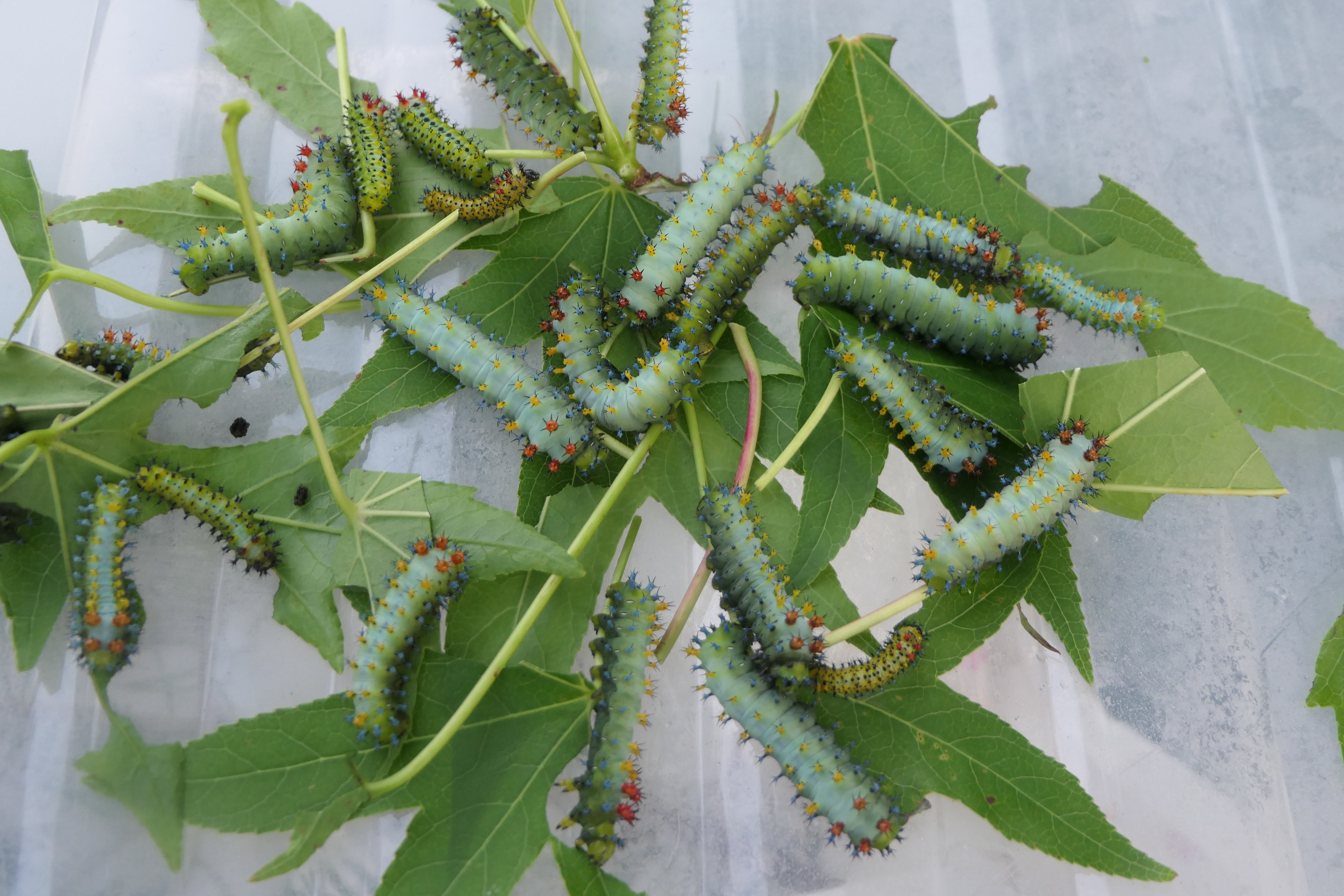
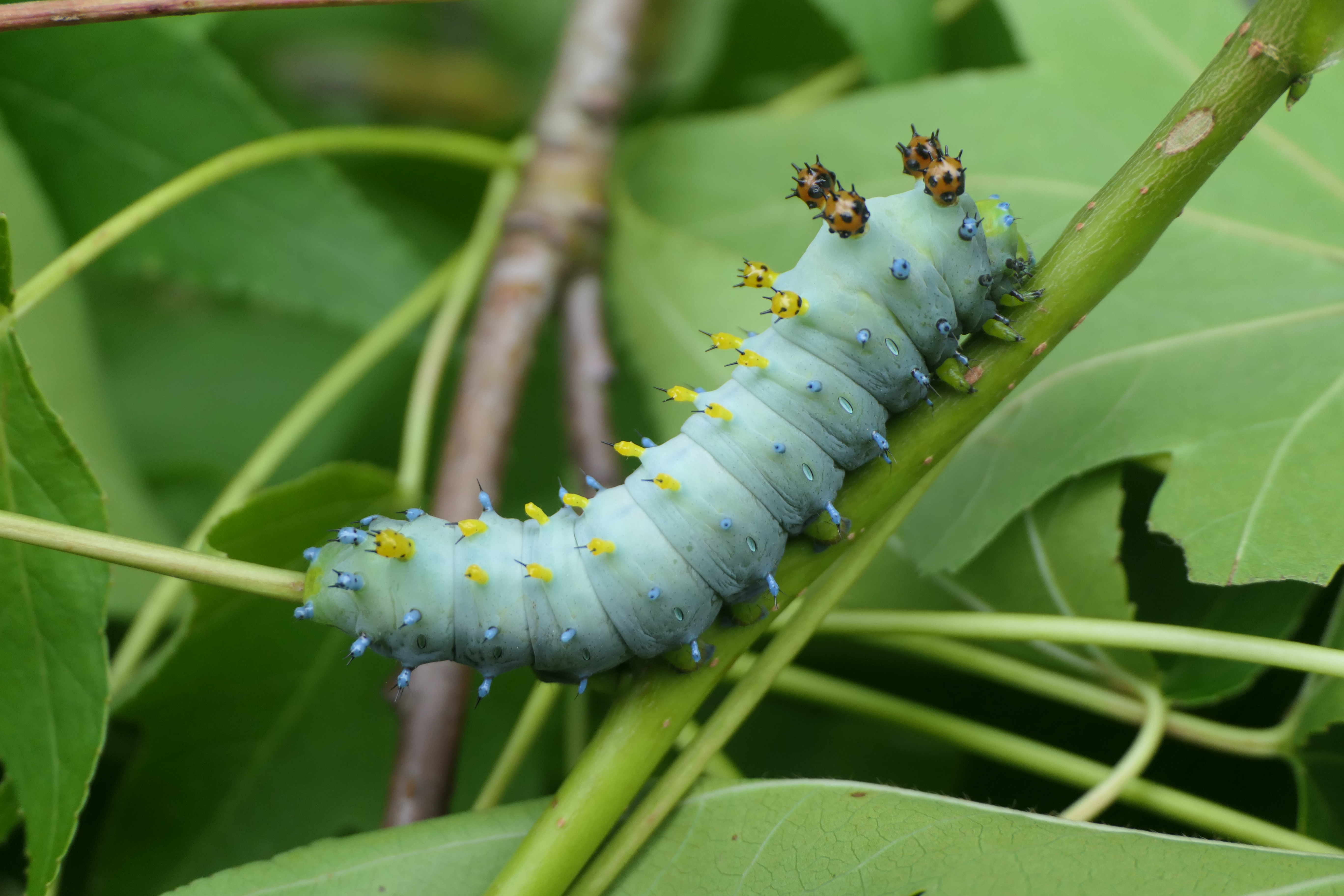
Once larvae reach L3 to L5, they really become quite beautiful. The tubercules form one colourful arrangement, with orange to reddish thorarical setae, transitioning into yellow ones on their backs and baby blue on their sides. Depending on the ambient temperature it generally takes them 6 to 8 weeks to grow from egg to fuly grown larvae. Despite their ‘funky’ appearance, the larvae are generally harmless. Nonetheless it is recommended not to frequently handle the larvae as they can be vulnerable to stress. This species is impressive in nearly every life stage!
From L3 to L5, give them air circulation if possible. Avoid stuffy or chronically wet conditions. However they do seem to tolerate some degree of humidity so long as the air can circulate. Also, do take population density into account. The larger the larvae are, the more personal space they demand; as a solitary species they do not enjoy being constantly disturbed by other larvae. This species wants some personal space. Lower population density also limits the spread of pathogens, considering how vulnerable this species can be to infections or diseases. Lots of larvae within the same enclosure are the perfect conditions for a bacteria or virus to infect all of them! Personally, I opted into rearing no more than 5 or 6 fully grow larvae pet net cage. Once fully grown, larvae can reach some impressive sizes. The real challenge in breeding this species is keeping the final two instars alive (L4-L5). If the conditions are right, survival rate can actually be on the higher side. It is getting the conditions right in the first place that can be the challenge! Some people report that they rarely have any trouble raising the larvae; perhaps if the (indoor) conditions of your environment just so happen to be acceptable for this species you will struggle less than others. It is simply one of those fussy species that refuse to develop well if they disagree with the conditions.
Another tip: anecdotally, alot of people also swear by rearing this species on a ‘living’ host tree (as in: as opposed to rearing them om cut branches or leaves). This can be done by allowing the larvae to free-roam on a potted plant or even a living plant outdoors; do make sure to contain the larvae within an enclosure or rearing sleeve still (to prevent them from becoming bird food). While I have not tried this method myself yet, I can believe it can lead to better results. When you cut branches from a tree, they lose nutritional value and water content over time as the plant slowly dessicates and eventually dies. When reared outdoors on a living plant this can also offer the larvae more exposure to natural conditions (such as sunlight, rainfall, a more natural day/light cycle) and if your local environment matches the habitat of H. cecropia, perhaps it is a better option.
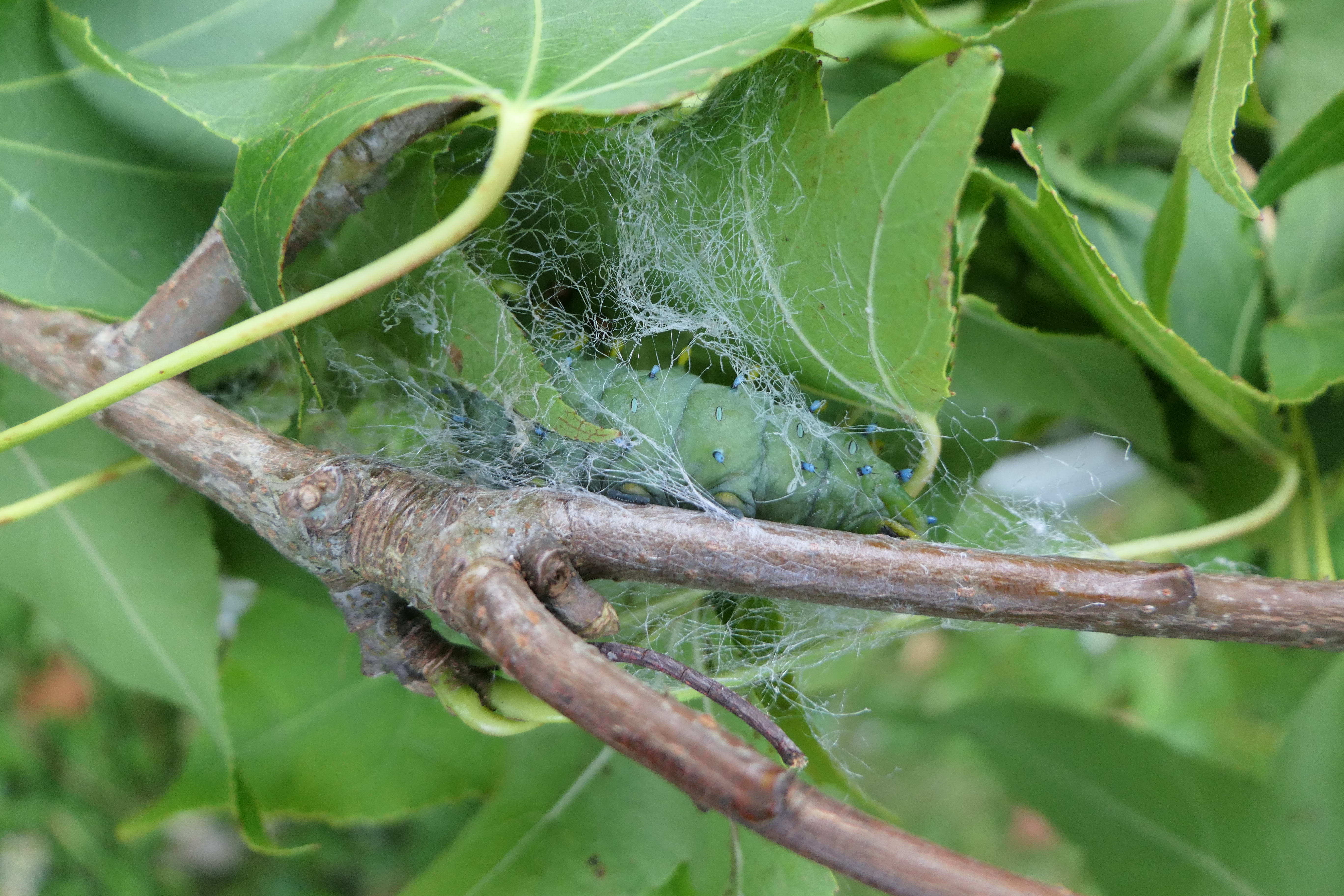
When done, the larvae finally spin a thick cocoon. Do not disturb larvae that are spinning. The silk thread is white at first but turns brown over time, especially as it comes into contact with water or humid air.
If you made it this far, rejoice! The hard part is now over. Both the cocoons and moth of this species are easy to care for. The cocoons are in fact pretty though and can survive harsh conditions. They owe this to the fact that they are double layered; they are essentially a cocoon within a cocoon! Interestingly there seem to be atleast two cocoon types. A smaller, dense cocoon type (‘compact’) and a larger, more airy and less dense cocoon type (‘baggy’). The exact function and/or the advantages of this interesting form of cocoon- dimorphism is not well known. One theory is that each cocoon type is somehow better suited when it comes to surviving certain types of conditions and that spreading the risk by simply using different survival strategies helps them survive unpredictable conditions better.
The most important thing to do, is to keep the pupae cold in winter. This species is adapted to temperate climates and in fact, when it comes to native Saturniidae species on the American continent, it is among one of the species with the most northern distributions (perhaps together with some of its cousins, Hyalophora gloveri, Antheraea polyphemus and Actias luna) with some northern records of H. cecropia including atleast Abitibi Canyon and also the southern edge of Lake Winnipeg and Lake Manobita in Canada. Temperatures here can be as low as -25C in January and February, which is a testament to the ability of the cocoons to harsh winters.
In fact, a cold winter seems to be a biological requirement for the cocoons of this species. A prolonged period of low temperatures combined with the pupae then finally warming up again is what seems to break the dormancy of the pupae and acts as an environmental cue for the moth to start developing in the pupa. Any exceptions to this are very rare (in only exceptionally rare cases do people report a second brood); so generally it is important to treat them as a single brooded (univoltune) with an obligate diapause. If not stored cold for several months, most of the cocoons simply never develop into moths. In this case it is wise to follow the seasons anyways since most of their food plants are also only seasonally available (in winter the vegetation drops its leaves). Personally I store the cocoons outdoors in winter, in a secure plastic box or pop up cage from about mid-October to mid April. Then I bring them indoors, and room temperature tends to trigger the development, causing moths to emerge 3-4 weeks after warming the cocoons. Some people hibernate them in their cooler basement or in a refridgerator; do keep in mind that refridgerators can have drying effect. In captivity, a temperature around 5C to 10C is effective. While they can survive lower temperatures, our goal is to make hibernation gentle and not as harsh as possible. If you can, shelter the pupae from rain, direct sunlight or even rodents (mice can chew the cocoons open and consume pupae). Keep them on the dry side. It is wise to keep the cocoons of this species intact; while it is tempting to open cocoons to look at the pupae, this could impair their ability to withstand lower temperatures or dry conditions.
Congratulations! The moths have emerged. Aren’t they beautiful? In a way they really almost are the atlas moths of North America. A comparison that is not entirely superficial, since they are not only in the same family, but also subfamily and even tribe as atlas moths; a direct relative indeed! (But not the only relative; the same applies to other Hyalophora but also Callosamia and Eupackardia). While famously large, when they are reared in captivity, the moths often do tend to come out smaller compared to their wild counterparts; only the healthiest and most well-fed bloodlines will produce full-size adults in captivity (and then again it depends on the rearing conditions too). It is said some of the largest individuals reach up to 190mm. The females are generally bigger than the males, as is true with most moth species. They have a lifespan of about 1 to 3 weeks. The more active males tend to have a shorter lifespan than the females. Lower temperatures seem to prolong their lifespan too. Like all other Saturniidae, they do not feed, and simply survive by metabolising the fat reserve stored in their abdomens, only to mate, lay eggs, and then effectively starve. In order to breed more moths, you will want to pair them!
Pairing: I honestly regard Hyalophora cecropia as one of the easier moths to pair in captivity, and they usually do so without hesitation. All you have to do is provide them a net cage, darkness, and preferably some airflow again. Try not to disturb them, and do not stress or handle the moths after sunset. If you have trouble getting these moths to mate, consider the quality of your livestock; I have found that broods that have a high degree of inbreeding(!) are often less interested in mating. What causes this I do not know – it might be a complicated answer relating to things like pheromones – so I can’t really speculate on the reasons. This is more of an issue in the pet trade, since hobbyists often let moths mate with their own siblings in captivity but it should not play a role in any bloodlines that were wild collected. Another issue could be too much artificial light (this can mess up their circadian rhythm and disturb their nocturnal activities) or a lack of airflow (males and females do have to find eachother in the dark based on scent which is hard if the smell saturates the whole room). When it comes to temperatures and humidity, they are very tolerant of a wide range of conditions; I have had the moths mate outdoors even during colder nights, as low as 12C or so, although warmer is generally better for them. Generally speaking this species is nocturnal and will pair in darkness, often beyond midnight and often even pushing their mating activities into early morning hours (4am-5am). Weirdly enough however, I have also observed them pairing during daytime in some occasions, especially in the afternoon on cloudy days (= low light conditions). It seems to be more rare but it does happen sometimes. I don’t know if this is exclusively a captivity thing or if it can also happen in nature.
Generally speaking, I don’t think many people will ever run into problems when it comes to getting Hyalophora cecropia to pair. They are generally very eager to procreate. If you already have some moth breeding experience, it should not be an obstacle to you. It is often quite easy to tell whenever a mating has occurred. After mating, the male often remains attached to the female in the morning and even throughout the day. The next evening the pair will seperate and the female will move on to lay eggs in the night while the male might look for a second mate! If male and female are attached by their abdomens you can be sure they have mated. Females can lay generous amounts of eggs, normally between 50 or 200 eggs (larger, fatter females tend to lay more). Save the eggs in a petri dish and in a few weeks you shall have more larvae!
Consider supporting the mission! What exactly makes some species of moths difficult to rear, and others way more easy? That question can be difficult to answer in some cases. You will often read generic explainations like ‘the larvae are sensitive’ and ‘the larvae need high/low humidity’; but these aren’t always very satisfactory and can be very circumstantial. Sometimes I don’t have the answers myself either. Especially when people tell you things like ‘just rear this species at room temperature bro!’. While room temperature should, in theory, indicate a temperature of about 21C (or 69F), in practice people use it differently. Informally, it often just means they reared the caterpillars indoors with climate control or anything. This disregards the fact that indoor conditions widely vary from person to person. How many people actually measure temperature and humidity? Often such advice is totally vibes based. Indoor conditions are not the same in, say, Spain or Sweden; Florida or Pennsylvania, Identifying the key elements and what exactly a species needs to thrive in captivity is not easy! Two people rearing a species indoors, even using the same setup and food plant, might get a completely different outcome simply due to them living in a different house. Some houses are dry, some houses are stuffy! Some are poorly isolated and others have stable temperatures. Even figuring out what exactly a species needs to thrive can be a major headache.
Using trail-end-error, this website (and by extension me as an author) are attempting to figure it all out. Not only does my website aim to document life cycles of moths as they are, but also how to do successful laboratory (or hobbyist) captive rearing of said species for study. This takes much time, resources, and effort; it is a painstaking, time consuming process of experimentation, trials and retrials, observing and improving – trying different enclosures, different food plants and more. This website is more than just a blog, it is a community– and crowdfunded- project. Your contributions help me raise more moths, and expose said moths to different conditions in order to see what works best; this helps the moth community as a whole! If you love my website and wish to see it grow and improve, consider becoming a member of our Patreon, checking out the Etsy webshop, or checking out the contributions page to make a difference. With your help, me, this website, and our moth research will only grow stronger, and we will be able to include more species! This website is the result of the work of a single person (me, Bart Coppens). I write all the articles myself, breed the moths myself and take all the notes and photographs! We promise you no A.I.slop (sadly, a lot of the information that A.I. knows about certain species moths was taken directly from my website!) and only real, personal information and observations.
Thank you for reading my article. This is the end of this page. Below you will find some useful links to help you navigate my website better or help you find more information that you need about moths and butterflies.
Dear reader – thank you very much for visiting! Your readership is much appreciated. Are you perhaps…. (see below)
- Not done browsing yet? Then click here to return to the homepage (HOMEPAGE)
- Looking for a specific species? Then click here to see the full species list (FULL SPECIES LIST)
- Looking for general (breeding)guides and information? Then click here to see the general information (GENERAL INFORMATION)
- Interested in a certain family? Then click here to see all featured Lepidoptera families (FAMILIES)
Citations: Coppens, B. (2026); Written by Bart Coppens; based on a real life breeding experience [for citations in literature and publications]
Was this information helpful to you? Then please consider contributing here (more information) to keep this information free and support the future of this website. This website is completely free to use, and crowdfunded. Contributions can be made via paypal, patreon, and several other ways.
All the funds I raise online will be invested in the website; in the form of new caresheets, but also rewriting and updating the old caresheets (some are scheduled to be rewritten), my educational websites, Youtube, breeding projects, the study of moths andconservation programs.
Donate button (Liberapay; credit card and VISA accepted)

Donate button (PayPal)

Become a member of my Patreon (Patreon)

Find me on YouTube

Find me on Instagram

Join the Discord server: Click here
Join the Whatsapp server: Click here
Facebook: Click here

