
PAGE UNDER CONSTRUCTION – COME BACK IN A FEW DAYS~!
There are very few moth species in this world that are as iconic as ‘Arctia caja’, also known as the ‘Garden Tiger Moth’. Not only is it highly colourful, it also has rather impressive variability. One could observe hundreds of garden tiger moths and come to the conclusion that indeed, no two moths look the same! The combination of spots and patterns on the wings of these moths are as unique as a fingerprint. The pattern of spots on the forewings and hindwings is unique to each individual, like the spots on a cow! Once a common and widespread species, it has sadly suffered a decline in populations. Now it often remains uncommon but thankfully still widespread; although it is hard to generalise, since the species has a very large distribution (found in temperate Europa into Russia into Asia, and even North America) and no doubt it is still as common as it used to be in the more remote and untouched parts of its geographical range.
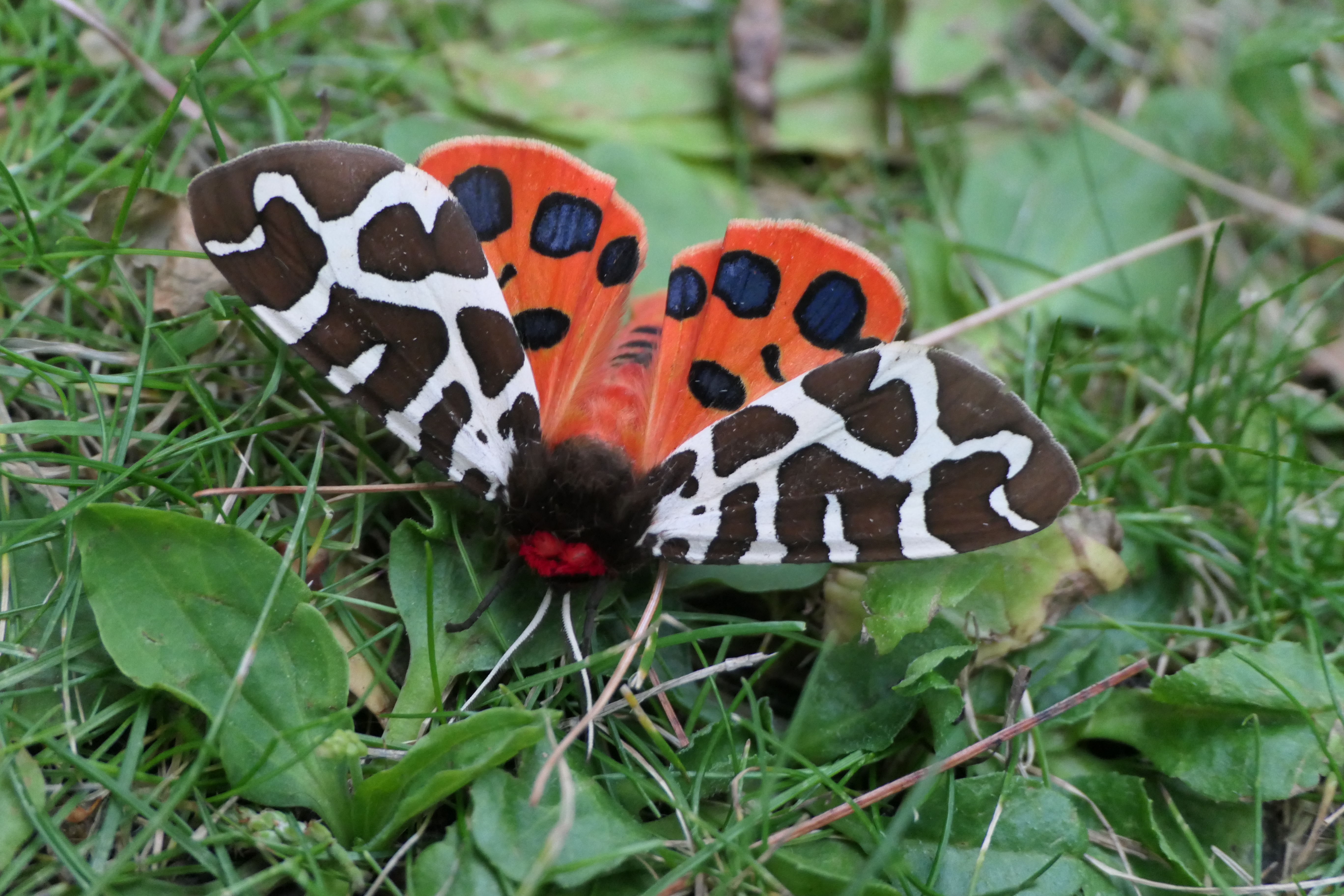
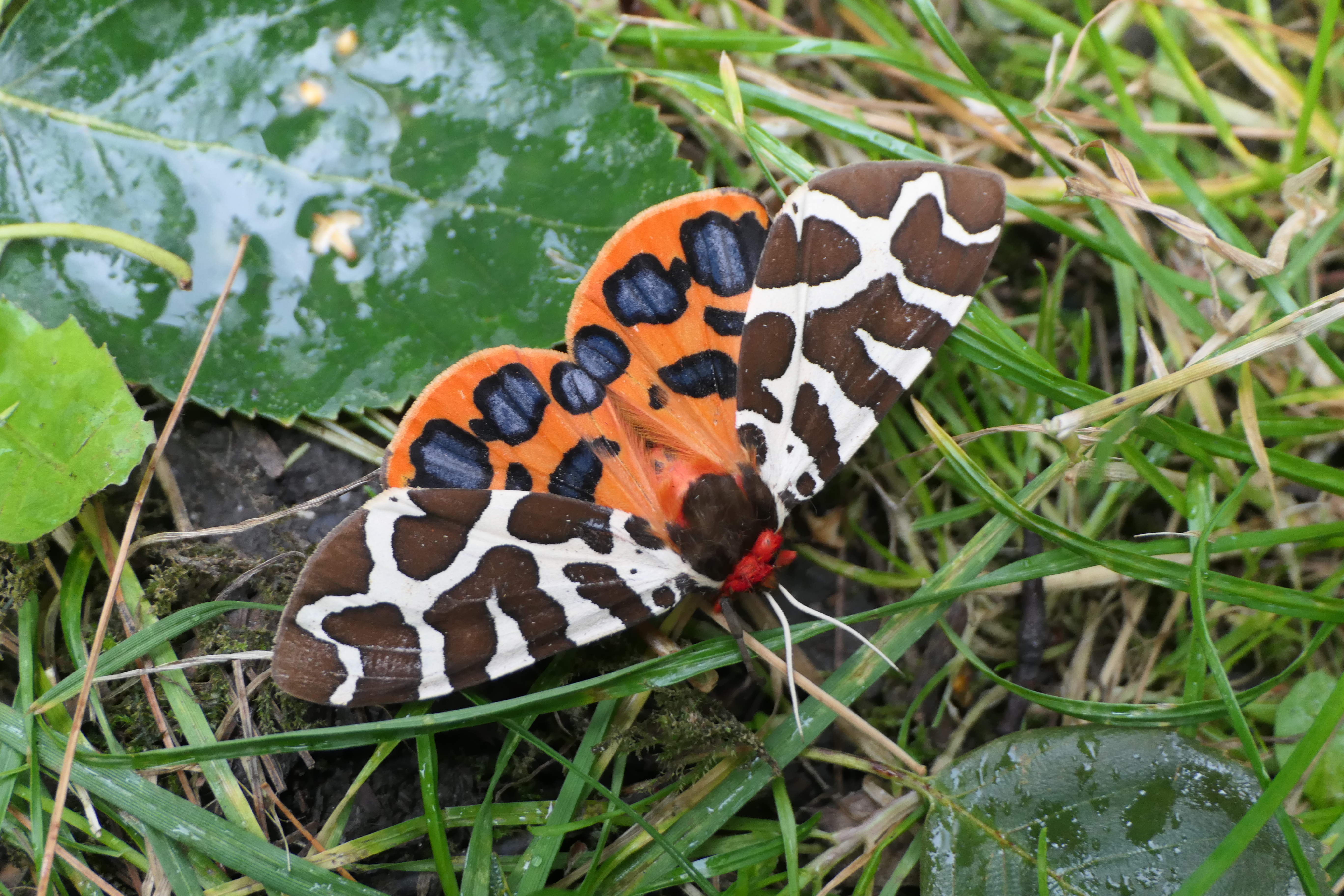
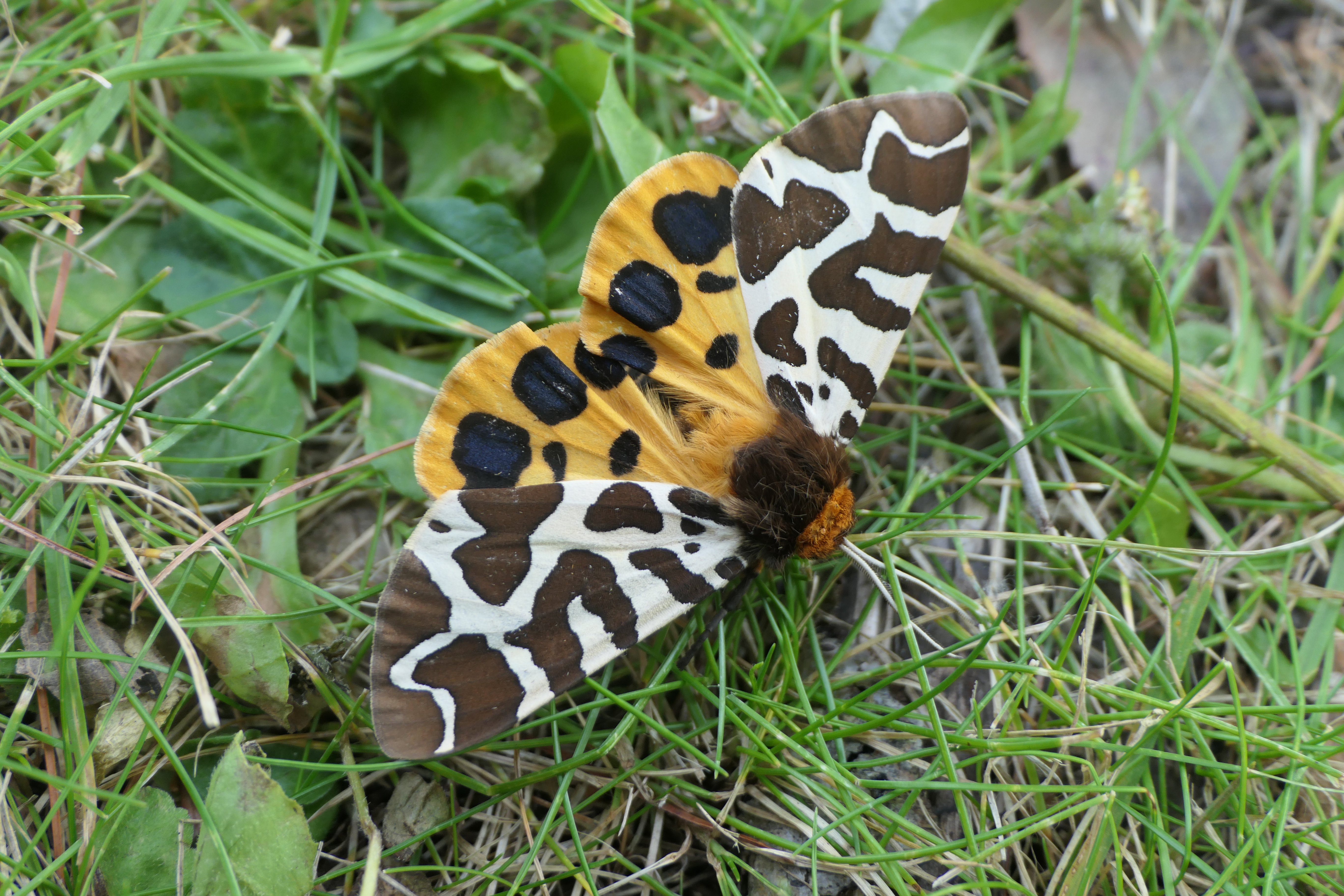
Your ‘average’ specimen of Arctia caja has brown or black spots on the forewings, and a dark orange (near red) abdomen and hindwings. However, the species has several distinct subspecies and forms. For example, subspecies A. c. wiskotti (transcaucasian, Armenia) has more extensive white patterns and pale yellowish hindwings while subspecies like A. c. sajana (Sayan mountains, Russia) are very dark. Meanwhile some specimens from the mountains in North Carolina (Appalachian) have almost entirely brown forewings with no trace of white markings, while A. c. phaeosoma (from parts of China and Korea) have light orange to yellow hindwings. There are many more forms and subspecies; more than I can practically name(!). It is their morphological variability that allows local forms and subspecies to establish themselves quickly when isolated populations form. This likely due to a combination of natural selection in the local environment – darker forms tend to have an advantage in colder environments, for thermoregulation reasons for example – and perhaps a bit of genetic drift in smaller and more isolated populations. Sometimes it is not exactly clear if local forms of Arctia caja constitute a distinct subspecies or just are just locally common colour forms (making the distinction in the first place is hard).
The spots forewing spots are generally brown or black. The hindwings and body are often dark orange (near red) but in more rare cases they can also be yellow, white, or black. Hindwings often have metallic black spots.
Arctia caja inhabits a broad variety of habitats, so long as they meet the specific demand sof this species: which is generally humid and cool places with a rich herb layer. This may include grasslands, pastures, forest fringes, riparian forests, coastal sand dune shrubland, marshes, fens, hillsides, montane forests and many types of open woodland.
The larvae of Arctia caja are very polyphagous and have been recorded eating hundreds(!) of different types of plants. However, the majority of the plants they prefer to feed on seem to be herbaceous plants. Larvae tend to roam the understory layer or herb layer, and browse on local herbs they encounter. Some of the most important host plants include plantain (Plantago sp.), stinging nettles (Urtica sp.), burdocks (Arctium sp.), hounds’s-tongue (Cynoglossum officinale), dandelion (Taxaracum sp.), docks and sorrels (Rumex sp.), Irises (Iris sp.), brambles (Rubus sp.), clovers (Trifolium sp.), meadowsweet (Filipendula ulmaria), willows (Salix sp.), blueberries/foxberries/bogberries (Vaccinium sp.), bird cherry (Prunus padus), alder (Alnus), and many more. They are quite the generalist when it comes to food plants, but the majority of food plants that they accept are low growing herbaceous plants (with some exceptions such as willow, cherry, birch and other woody plants).
The larvae are also remarkably hairy. They generally prefer to feed closer to the ground (0m-3m) on low growing herbaceous plants. On colder days they can be seen basking in the sunlight on host plants; larvae are also rather nomadic and are often seen crossing trails and roads that run through their habitat (and by caterpillar standards they can run rather fast). Interesting to note is that this species hibernates as larvae; the moths of this single-brooded species generally fly between June to August. After reproducing themselves and laying eggs, the larvae of the next generation won’t turn into moths until next year(!). Larvae feed themselves with various plants from summer to autumn, until temperatures become uncomfortably cold for the larvae.
During this time, the half-grown larva will find a comfortable spot to hibernate. They will hide deep in leaf litter or compost, or under rocks; so long as they are adequately sheltered from the elements. Then the larvae will remain dormant until next spring, and often resume their feeding activities from May to June-July. Then finally once fully grown, the larvae spin a very thin rubbery cocoon and pupate. Pupation tends to be rather quick and moths appear between 3 to 5 weeks (depending on ambient temperature). Then, the short-lived moths mate, lay eggs and die, repeating the cycle. This explains why the larvae prefer humid habitats; during their diapause they are vulnerable to drying out.
I personally found the larvae of Arctia caja to be (mostly) harmless, but other people have reported minor itchy sensations after handling them.
Captive breeding projects have managed to create many unusual Arctia caja forms; including completely black specimens, specimens with no spots at all, forms with white hindwings and more. While some of these extreme forms can occur in nature, it appears to be exceptionally rare. However, their high variability makes them an excellent candidate for selective breeding projects.
- Difficulty rating:
- Rearing difficulty: 5/10 (From egg to pupa)
- Pairing difficulty: 3.5/10 (Achieving copulations)
- Host plants: Some of the most important host plants include plantain (Plantago sp.), stinging nettles (Urtica sp.), burdocks (Arctium sp.), hounds’s-tongue (Cynoglossum officinale), dandelion (Taxaracum sp.), docks and sorrels (Rumex sp.), Irises (Iris sp.), brambles (Rubus sp.), clovers (Trifolium sp.), meadowsweet (Filipendula ulmaria), willows (Salix sp.), blueberries/foxberries/bogberries (Vaccinium sp.), bird cherry (Prunus padus), alder (Alnus) – it has also been reared using cabbage (Brassica sp.), sweetgum (Liquidambar), ragwort (Senecio sp.), strawberry (Fragaria ananassa), apple (Malus sp.), yarrow (Achillea sp.), dead-nettles (Lamium sp.), lettuce (Latuca sativa, but avoid using iceberg lettuce since the high water content makes a mess), birch (Betula), bindweeds (Convolvulus/Calystegia) and more. When rearing this moth is is recommended to give the larvae a salad(!) of different host plants mixed together, instead rearing the larvae with one single plant species. In nature the larvae also tend to roam and browse on different plants that they encounter in their lifetime and is likely more beneficial to their health. However, it is also possible to rear them using just one single host plant (I’ve often done it by exclusively feeding them dandelion or Taxaracum). Various host plants from the plant families of cherry (Rosaceae), legumes (Fabaceae), asters (Asteraceae), nettles (Urticaceae), hemp (Cannabaceae), Irises (Iridaceae), willows (Salicaceae), plantains (Plantaginaceae) are often happily accepted by the caterpillars.
- Natural range: Very widespread. Found nearly all over Europe with the exception of the most southern parts of Spain and Portugal and the most northern parts of Scandinavia (where seems to hug the coastline, but becomes rare inland). It exists in Greece but becomes more rare towards Turkey, where it mostly present in the northern side of the country, hugging the Black Sea and Caucasus mountains (Georgia/Turkey), also present in Armenia and Azerbadijan. Then it is also found from European Russia, all the way from western Russia into the Far East regions including northern Kazakhstan, northern Mongonia, northeast China, Korea and Japan. Also present in the Altai Mountains and Tien Shan (Celestial mountains) mountains, including Kyrgyzistan, Tajikistan and northern Xinjang (China). Then once again present in the United States of America and Canada; present in isolated populations from North Carolina into New York (U.S.A), Vermont, New Hampshire, Maine, New Brunswick, then sort of hugging the border between the U.S.A and Canada from the west-coast to the east-coast (New Brunswick into Alberta, Canada). From there the species seems to hug the Rocky Mountains where it is found from southern British Columbia into New Mexico, but also clings from the Pacific coastline from British Columbia to northern California. – Note: The Himalayan population of Arctia caja was recently classified as a new species, Arctia martinhoneyi; specimens from Pakistan and Afghanistan should no longer be classified Arctia caja (?).
- Polyphagous: Yes (extremely!)
- Generations: Univoltine (only one generation a year). However, can produce multiple generations per year in captivity
- Family: Erebidae (Arctiidae)
- Pupation: Spins a loose cocoon
- Prefered climate: Temperate, cool, humid places. Can be found in many habitats and feeds on many host plants, but it is not completely generalist as since the species is vulnerable to too dry or too hot summers; larvae also require colder conditions to succesfully hibernate. In places with a hotter climate it seems to be more restricted to the cooler mountains, or coastal areas (examples: California, USA – Turkey, Portugal and Spain).
- Special notes: Arctia caja can detect the ultrasonic sound of bats with an “ear” – like membrane, and respond to them by making ultrasonic sounds themselves, warning the bat of their toxicity
- Wingspan: 40 – 60 mm
- Binomial name: Arctia caja (Linnaeus, 1758)
If you are someone that enjoys rearing/breeding moths in captivity, then Arctia caja is the perfect species for you. It is a species that is generally easy to rear and beginner friendly, if you have the patience tolerate the longer development time of the larvae in some occasions. It is also a charming and colourful species, that is so polyphagous that almost everyone will have access to plants to feed the caterpillars with.
The only challenging part of breeding Arctia caja is hibernating the larvae; however this seems to be completely optional in captivity. In most cases, when the larvae are reared in room-temperature (21C) they will simply not hibernate at all. Cold temperatures must be one of the triggers that induce hibernation in the larvae. Skipping the hibernation does not seem to have any detrimental effects on the moths or their health, if not for the fact that their life cycle indoors will probably not align with their natural flight seasons anymore (which is not really a problem for most moth breeders, but it depends on why you’re trying to rear them of course).
Thank you for reading my article. This is the end of this page. Below you will find some useful links to help you navigate my website better or help you find more information that you need about moths and butterflies.
Dear reader – thank you very much for visiting! Your readership is much appreciated. Are you perhaps…. (see below)
- Not done browsing yet? Then click here to return to the homepage (HOMEPAGE)
- Looking for a specific species? Then click here to see the full species list (FULL SPECIES LIST)
- Looking for general (breeding)guides and information? Then click here to see the general information (GENERAL INFORMATION)
- Interested in a certain family? Then click here to see all featured Lepidoptera families (FAMILIES)
Citations: Coppens, B. (2019); Written by Bart Coppens; based on a real life breeding experience [for citations in literature and publications]
Was this information helpful to you? Then please consider contributing here (more information) to keep this information free and support the future of this website. This website is completely free to use, and crowdfunded. Contributions can be made via paypal, patreon, and several other ways.
All the funds I raise online will be invested in the website; in the form of new caresheets, but also rewriting and updating the old caresheets (some are scheduled to be rewritten), my educational websites, Youtube, breeding projects, the study of moths andconservation programs.
Donate button (Liberapay; credit card and VISA accepted)

Donate button (PayPal)

Become a member of my Patreon (Patreon)

Find me on YouTube

Find me on Instagram

Join the Discord server: Click here
Join the Whatsapp server: Click here
Buy insect cocoons: Click here
Facebook: Click here
 Welcome, visitor!
Hey! Great website! I have now a dozens of Arctia Caja caterpillar, I’m giving them Taraxacum but they don’t eat at all, neither they produce excrements. How can I do??? Any tips?
LikeLike
How odd, perhaps they are trying to overwinter, many Arctiidae have low metabolism in winter since they survive as young caterpillars..although they still eat during this time, but minimally so. How are they doing?
LikeLike
Now all the caterpillars are dead but two that started feeding and growing.
Always reared between 19°-20° C, maybe all the dead simply didn’t like taraxacum as they were reared on mallow before, from the first breeder.
LikeLike
I have an invasion (1000s)of these in a greenhouse I have shut down for the season. They are also in the grass & on the walkways outside of it. I’m afraid they will spread to my greenhouse that I am currently growing in and devour my crops. Can this be prevented? Do they run some kind of cycle of overproduction every few years?
LikeLiked by 1 person
I would not worry about them Franny, although the caterpillars can be very hungry they will struggle to reproduce themselves in a greenhouse
LikeLike
If i want to over winter the Garden tiger moth Caterpillers, where is the best place to put them? I think in my home would be too warm. Would being out on the balcony be better?
LikeLike
Can someone help please. My garden tiger moth pupa have stopped moving. Do you think they are dead?
LikeLike
Hi. I have just found a tiger moth and a little batch off eggs. So has my dog. I need to move the eggs somewhere out of his reach but dont want to harm them. Any ideas? They are on garden sofa fabric. Can I slide them off into an area of the garden doggo can’t get to or will that harm the eggs? The moth has now flown off.
Many thanks
LikeLike
I have three caterpillars that my daughter and I have been caring for. They have all formed cocoons, and one just hatched! How do I feed this moth now??
The other two haven’t hatched yet, and made their cocoons attached to the door of their habitat. I want to care for the one that has hatched without injuring the other two. I need any advice you have please.
Thank you!
LikeLike
My caterpillar has lost its hair and isn’t moving, assuming it died. It was leaving silks around the tub it was in and had food. What did it likely die from?
LikeLike