
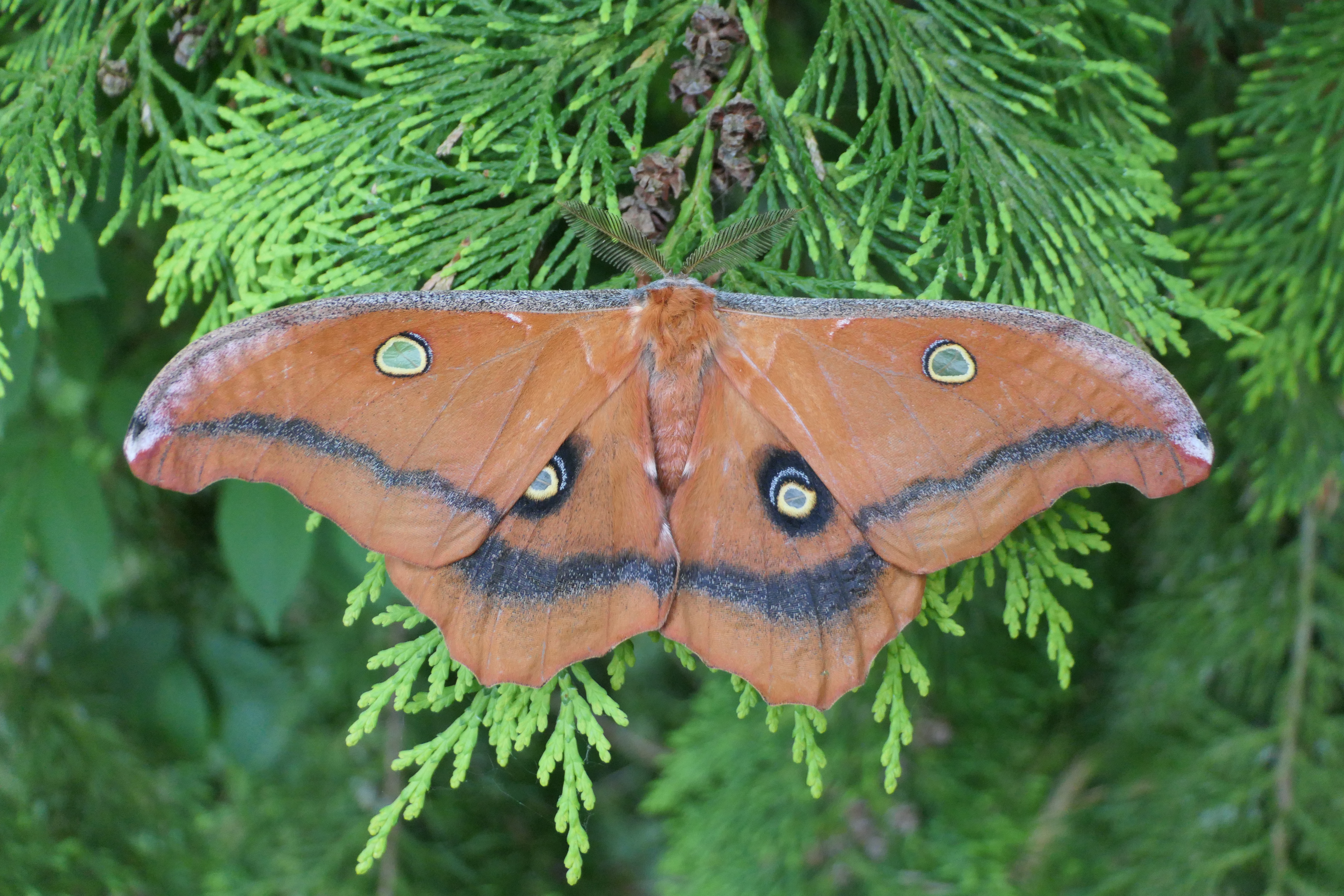
Antheraea montezuma is an enigmatic, and uncommon species of Saturniidae (Emperor moth) that is endemic to Mexico, atleast in the states of Hidalgo, Veracruz and Puebla – but also in San Luis Potosi, Campeche, Distrito Federal, and Guerrero. It is reportedly ‘widespread’ in the Sierra Madre, occidental and oriental in Mexico. What makes this species stand out are the very unique larvae, with iridescent metallic pink/purple patches on their body, and the imagoes with scalloped (jagged) wing edges that are typical for this species.
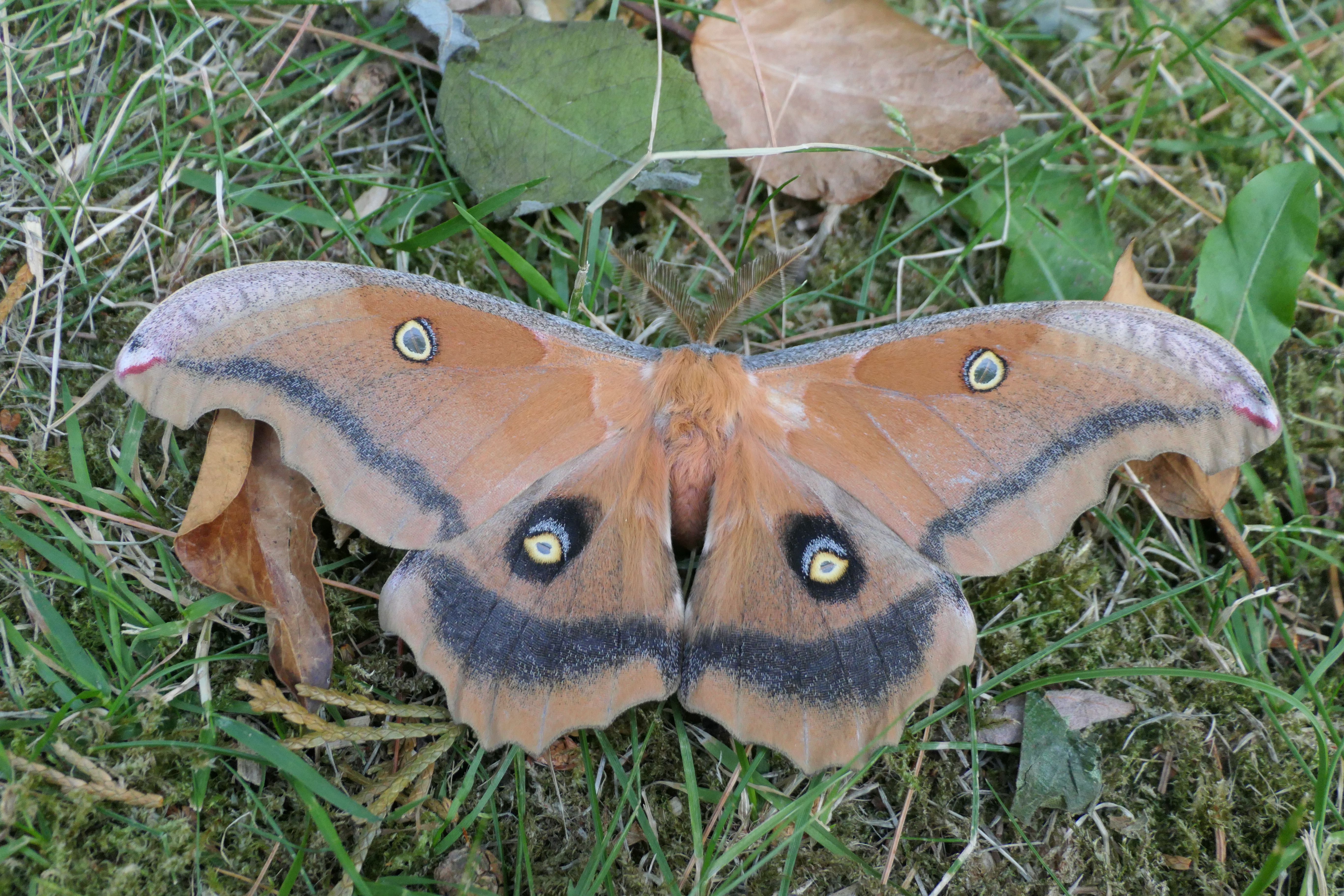
This species has just one brood a year(!). Generally speaking adults are found from as early as May to as late as August, but the ‘peak’ flight activity when most moths are found is June and July.
It is a high altitude species associated with mountains (1200m-3000m); in these localities they face warm and dry days, but cold nights due to the elevation. Here they feed on native oak tree (Quercus) species – reportedly, over 161 species of Quercus can be found in Mexico(!) that are native. Although there are few records of the larvae feeding on the host plants in the wild, some of the Quercus species available in their habitat include Quercus chihuahuensis, Quercus grisea, Quercus canbyi, Quercus rugosa, Quercus scytophylla, Quercus laceyi, Quercus repanda and more – but it is hard to be sure what species of Quercus they truly prefer in the wild. In captivity however, several entomologists have done rearing experiments with them, and it appears that the insect can be reared on a wide range of Quercus species without much issue – including species that are not even native to Mexico such as Quercus suber, Quercus ilex, Quercus cerris, Quercus robur and others. This suggests that to some extent, the species is open minded and may or may not make use of a broader variety of Quercus species in the wild. They do demonstrate a preference for oaks of the ‘white oak’ [Quercus subg. Quercus] group; and besides that fact, it appears that the larvae also seem to grow well on types of oak trees that are evergreen. This may suggest that in the wild, Antheraea montezuma also feeds on the completely evergreen or drought deciduous (semi-deciduous) species of Quercus that may be encountered in Mexico.

Just as spectacular as the moths, are their larvae. The caterpillars have highly iridescent pink/metallic patches. They appear to be well-adapted to dry and warm conditions, and feed on evergreen and semi-evergreen species of oak tree, that in some cases, have though and dry leaves.
In Mexico, the species is reportedly found in higher altitude forests that include local species of oak tree (Quercus). The species is single brooded; cocoons more or less ‘hibernate’ until the next year before the moths emerge from them. Reportedly, their environment features cold nights but hot days.
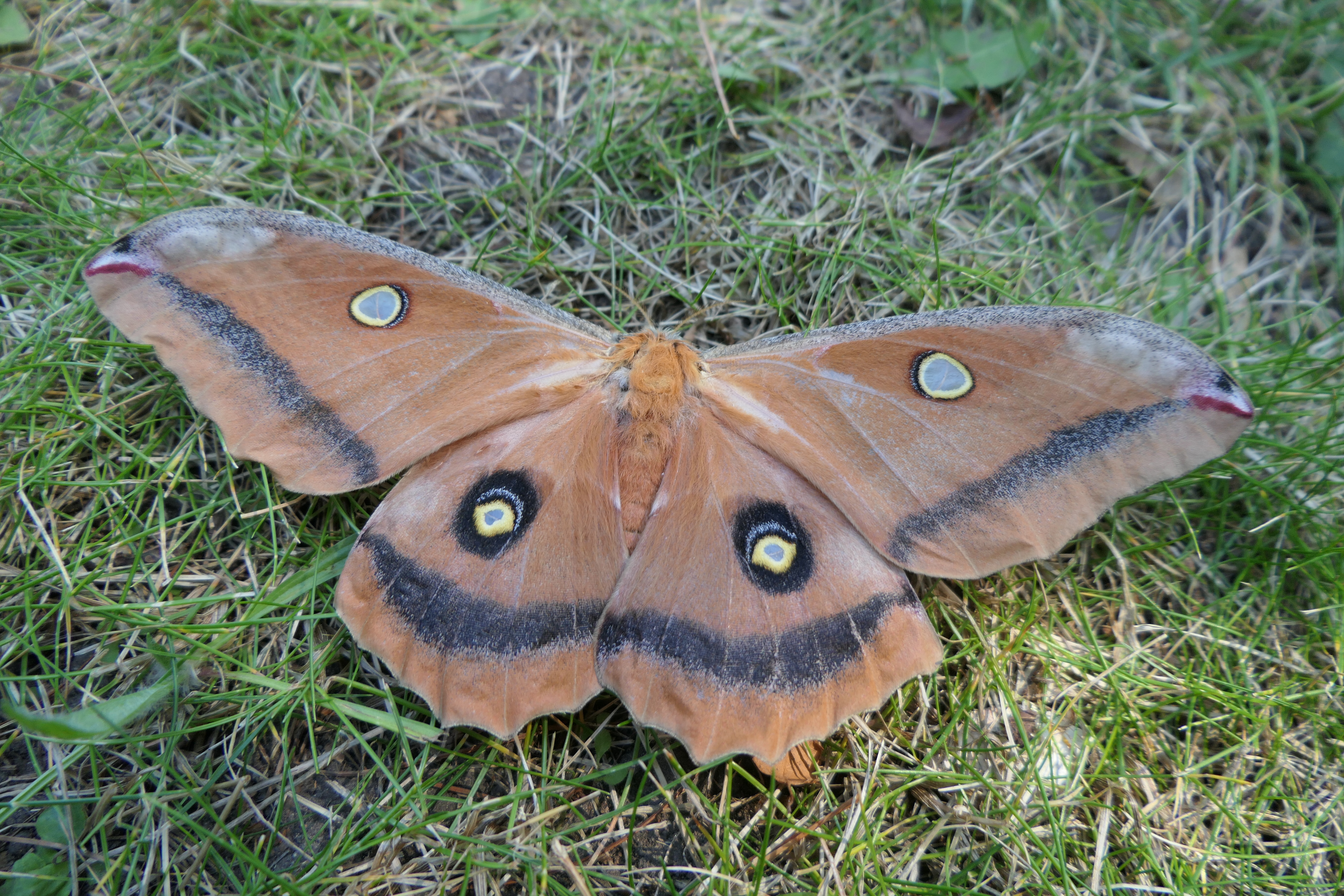
Note: There is a second, similar species in Mexico – Antheraea meridiana (Naumann & Nogueira, 2021) that replaces A. montezuma in the Sierra Madre del Sur of Mexico in the states of Guerrero & Oaxaca. Visually they look very similar to montezuma; but there are differences. For example, the larvae of A. meridiana are hairy while A. montezuma larvae are smoother and have smaller bristles- and A. meridiana has a thinner forewing postmedian line and different genitalia.
- Difficulty rating: Challenging – This rating means that this species is challenging to breed, and that you will need some advanced experience in order to be succesful. While the moths pair somewhat easily and cocoons are easy too take care of, it’s rearing the larvae that is the tricky part. If you are a beginner, this species is not recommended for you.
- Rearing difficulty: 7.5/10 (From egg to pupa)
- Pairing difficulty: 5.5/10 (Achieving copulations)
- Host plants: Oak trees! Oak trees (Quercus) of several kinds.
- Natural range: Mexico
- Polyphagous: Not very; seems to mostly just eat oak tree (Quercus). I’m not sure if other host plants are possible [other Fagaceae are worth a try too, perhaps] but larvae seem to reject most of them. It does however feed on many species of Quercus! But mainly just Quercus.
- Generations: Seems to be univoltine (single brooded). The cocoons must hibernate before moths show up.
- Family: Saturniidae (silkmoths)
- Pupation: Cocoon (silk encasing)
- Prefered climate: Hot and dry days, colder and more humid nights
- Wingspan: 150mm – 170mm. Similar to Antheraea polyphemus. Much to my suprise, the males are bigger than females. In Saturniidae moths this is highly unusual. This trait they share with Antheraea godmani, a related species.
- Binomial name: Antheraea montezuma (Salle, 1856)
- Special notes: The biggest challenge lies in rearing the larvae; in captivity, the cocoons and the moths are easy to take care of. The caterpillars, however, can be somewhat sensitive. They prefer to be on the more warm and dry side, it seems. Too much humidity can make the larvae sick and result in infections. They also prefer evergreen oak tree with hard and dry leaves; I had good result with Quercus ilex and Quercus suber, despite them being non-native food plants. Suprisingly, I had worse results with Quercus robur and Quercus rubra (in most Saturniidae it’s the opposite – they struggle to feed on the dry and hard leaves of evergreen oak; but Antheraea montezuma is well adapted to them it seems).
The eggs of Antheraea montezuma are easy to hatch in captivity. Place them in plastic containers or petri dishes! All they need is temperatures around 21C (room temp), some gentle humidity, and expect to see caterpillars in about two weeks time.


The eggs are rather oval and have a pale ‘creamy’ colour; after two weeks, the larvae consume part of their eggshells and start wandering.
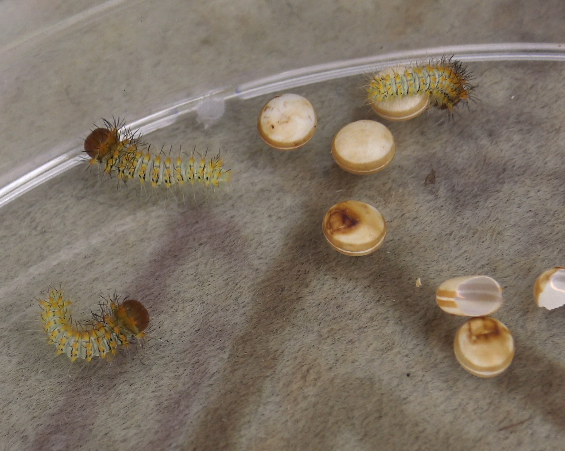


The first instar(s) can be reared in plastic boxes, with cut food plant in water bttles to keep it fresh. Although this species seems to dislike stuffy and too humid conditions, it seems to be O.K for the first two instars. Make sure you do not overcrowd them and replace the food for fresh leaves every few days!
The later instars (L3-L4-L5) definitely need a larger, well aeriated enclosure. They actually seem to enjoy being reared in plastic boxes, as long as large ventilation grids are installed. They can also be reared in pop-up cages in instar 4 & instar 5 (provided the indoors conditions are not tóó dry). This species seems to like being on the drier (but not extremely dry) side although I did mist them with water once in a while to elicit drinking behaviour. The best enclosures for them seem to be well ventilated, but not 100% ventilated.
I reared this species indoors, in the summer, in the Netherlands; with no artificial heating at all. Temperatures fluctuated between 30C (warmest days) and 18C (cooler days). On average, most days were warmer than 23C+ so they were kept relatively warm(ish). The relative humidity was around 70% to 80%. I reared them on a mix of Quercus robur, Quercus ilex and Quercus suber. They vastly preferred Quercus suber; the larvae ate all of it first.


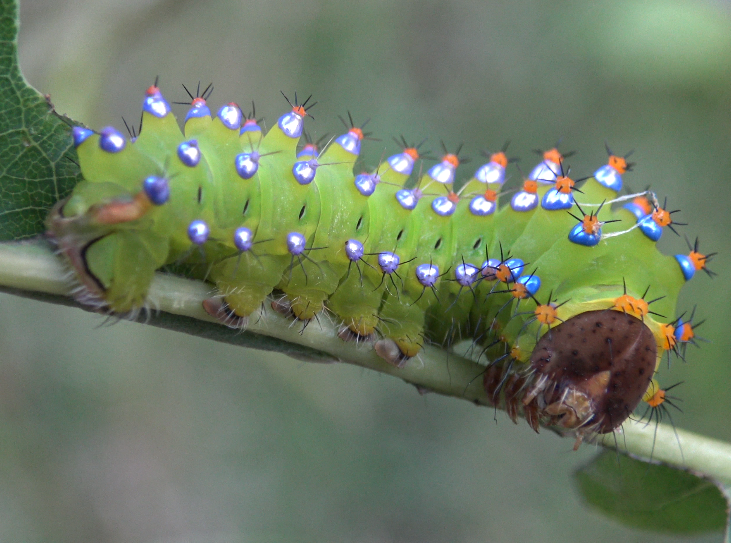

In the 3rd instar and beyond; the larvae became gorgeous. Perhaps they are the most beautiful larvae I’ve seen – they have incredibly bright iridescent markings that, depending on the angle, have a shimmer that is rather pink, purple, blue , or silver.
In captivity, the species seems to indiscriminately feed on various kinds of Quercus although they showed a strong preference for any oak of the evergreen kind with though, dry leaves.


Once fully grown, they become incredibly beautiful!

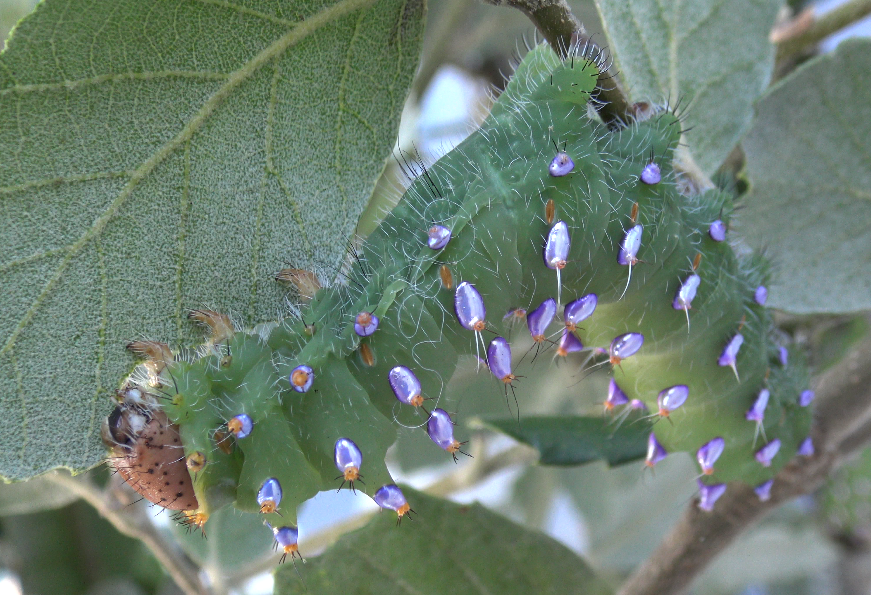


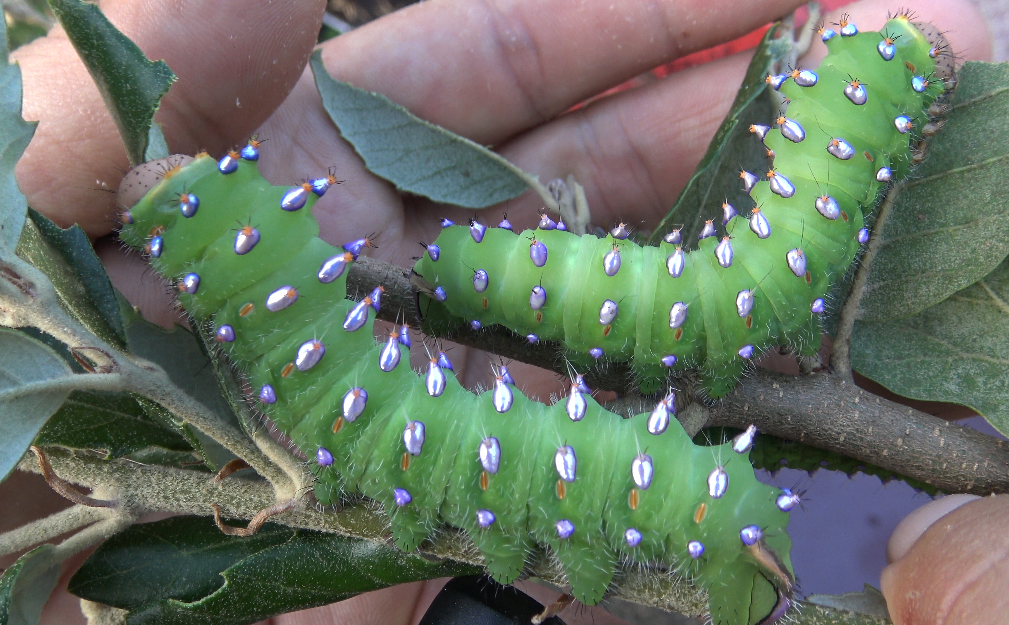
People attempt to rear this species, typically have mixed results. Sometimes the larvae can have higher survival rates; but in many cases it seems that breeders lose their brood due to disease and infections. Therefore it is considered to be a species that is recommended for more experienced moth breeders.
However, if you’ve done it properly – they will begin spinning cocoons. The cocoons are oval, and attached to the host plant with a silk pad.
Store the cocoons of Antheraea montezuma cold for several months, and warm them up in spring. They seem to be rather cold hardy.


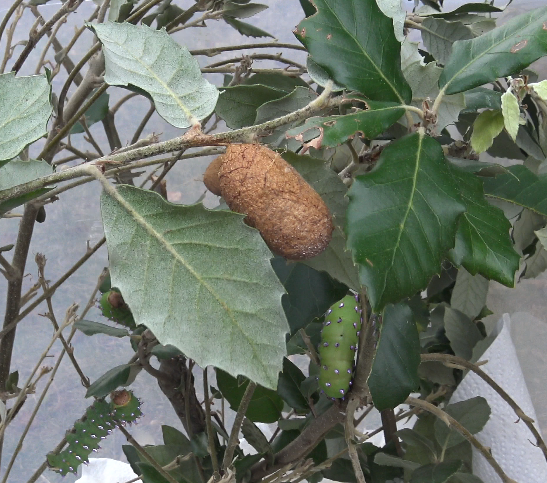
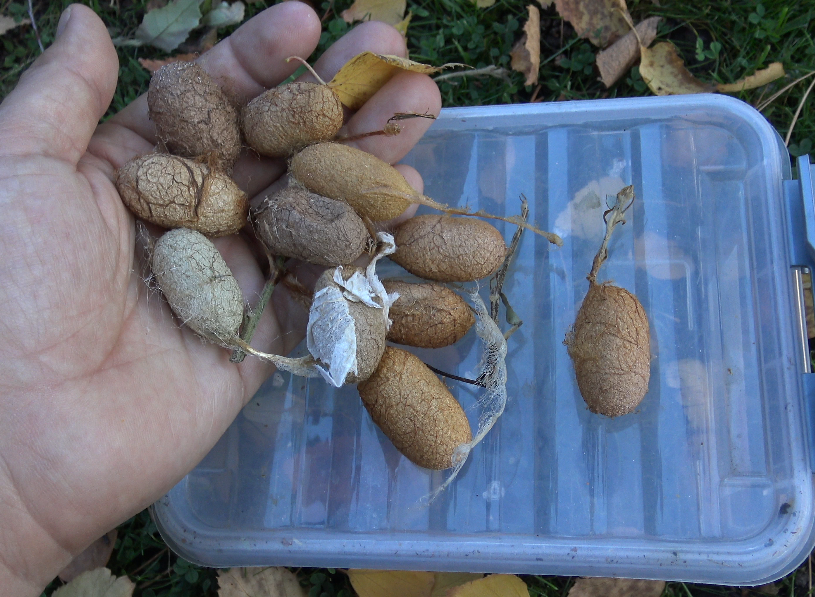
The cocoons of Antheraea montezuma are very easy to take care of. Most importantly, they must hibernate before any moths will appear. This means you’ll have to find a way to store them cold in winter.
I overwintered mine outdoors(!) in the Netherlands, Europe(!) and they were completely fine. It seems as if the cocoons can be remarkably cold hardy. I would recommend temperatures closer to 5C-10C (preferably frost free). I hibernate my cocoons from November to April.
This species appears to exhibit variation; not just when it comes to the wing colour but also the shape of the wings. The ‘scalloped’ wing edge that is typical in this species, seems to be a variable trait. Some individuals have smoother wings that almost come close to Antheraea polyphemus, whereas other individuals have strongly jagged wing edges.

Males seem variable; there are lighter (sandy beige) to darker (rusty orange) forms. Some individuals have a thick black postmarginal line, whereas the black scaling is thinner and more subtle in other individuals.
In the wild, it appears that moths are found from May to October; with peak numbers in June and July. In captivity, most of my moths also emerged in June and July which coincides with their flight time in Mexico.
Antheraea montezuma is a very difficult species to photograph or handle; the slightest touch will make them freak out. In response, the moths drop to the floor, and flop back and forth.


In captivity, Antheraea montezuma seems to mate rather easily! Males & females in the same enclosure will quickly pair at night, if left to their own devices (in a dark room, with some airflow). After that, the female may lay many fertile eggs, and the life cycle begins anew!

Antheraea montezuma, as with any Saturniidae, are somewhat short lived; expect them to live for 7 to 10 days. Life cycle completed!
Thank you for reading my article. This is the end of this page. Below you will find some useful links to help you navigate my website better or help you find more information that you need about moths and butterflies.
Dear reader – thank you very much for visiting! Your readership is much appreciated. Are you perhaps…. (see below)
- Not done browsing yet? Then click here to return to the homepage (HOMEPAGE)
- Looking for a specific species? Then click here to see the full species list (FULL SPECIES LIST)
- Looking for general (breeding)guides and information? Then click here to see the general information (GENERAL INFORMATION)
- Interested in a certain family? Then click here to see all featured Lepidoptera families (FAMILIES)
Citations: Coppens, B. (2023); Written by Bart Coppens; based on a real life breeding experience [for citations in literature and publications]
Was this information helpful to you? Then please consider contributing here (more information) to keep this information free and support the future of this website. This website is completely free to use, and crowdfunded. Contributions can be made via paypal, patreon, and several other ways.
All the funds I raise online will be invested in the website; in the form of new caresheets, but also rewriting and updating the old caresheets (some are scheduled to be rewritten), my educational websites, Youtube, breeding projects, the study of moths andconservation programs.
Donate button (Liberapay; credit card and VISA accepted)

Donate button (PayPal)
Become a member of my Patreon (Patreon)
Find me on YouTube
Find me on Instagram
Join the Discord server: Click here
Join the Whatsapp server: Click here
Facebook: Click here
 Welcome, visitor!