
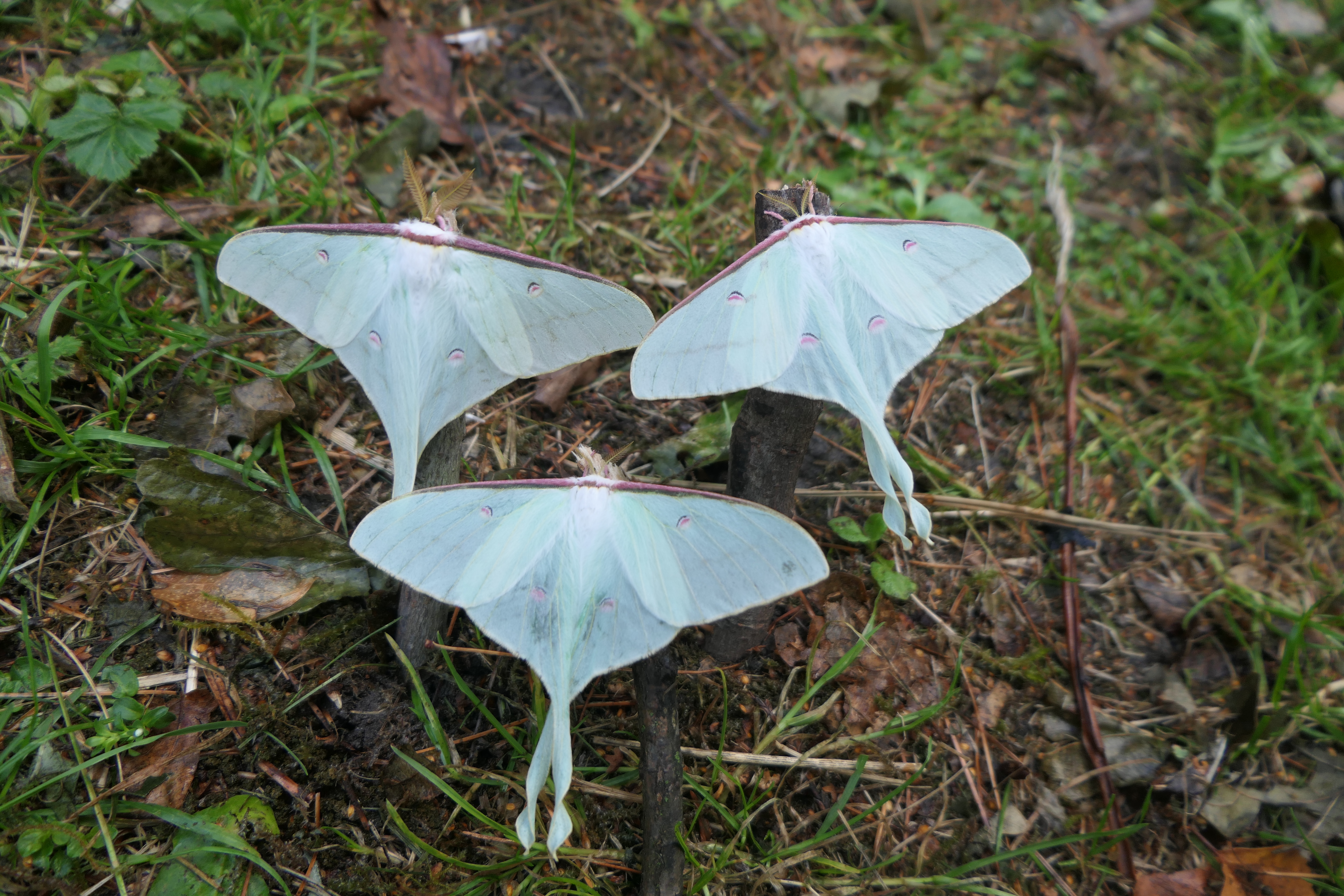
Once in a while, you come across a species that is truly mythical. Actias neidhoeferi is known as the Taiwanese moon moth, or Mini moon moth. It is a very rare, and also very small species of Actias that is endemic to the mountains of Taiwan (Miaoli County, East Coast National Scenic Area; -Nantou County in general, Yilan County, Taipingshan National Forest area, Hualien Country in the mountains east of Taroko National Park – and generally in the mountainous regions of central Taiwan; also present but more rare in the South e.g parts of Taitung Country such as Xiangyang National Forest Recreation Area) where it is found in higher altitudes (1900m-2600m). It is so seldomly observed or studied that entomologists have only managed to document and publish its full life cycle for the first time in 2013, which is not only relatively recent but also 45 years after the species was descibed to science!

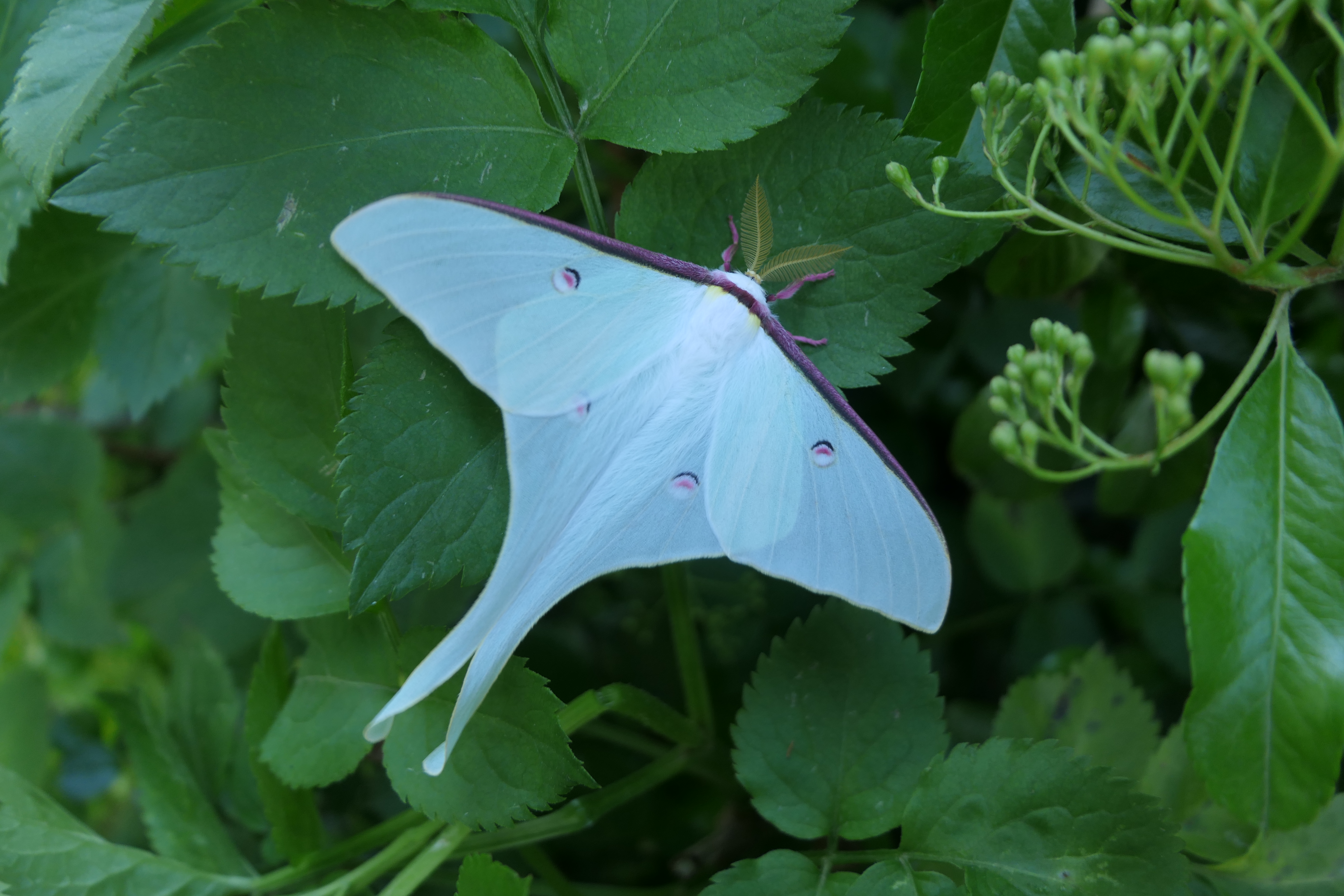
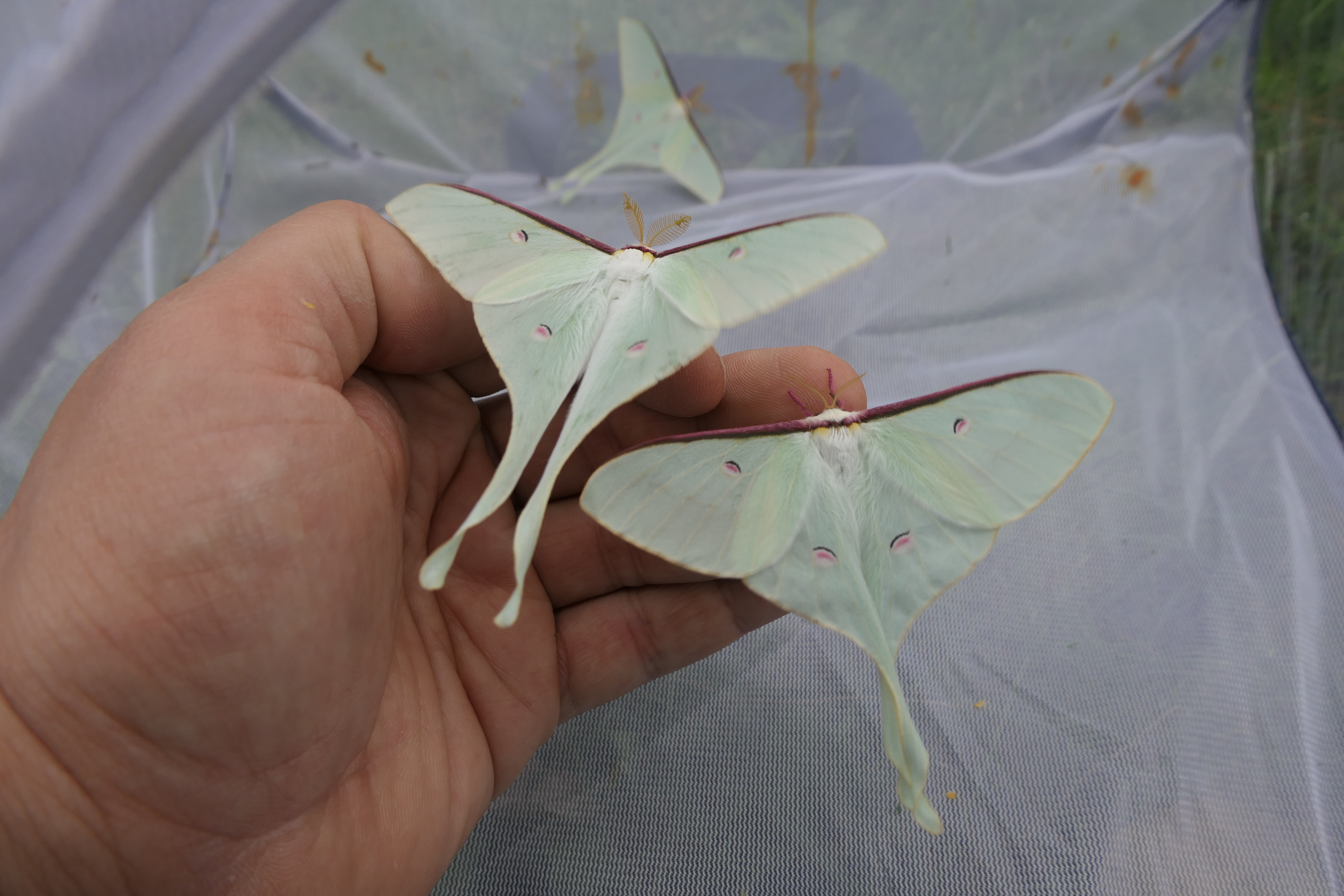
Actias neidhoeferi is one of the smallest species of moon moths; their wingspan generally ranges from 65mm to 100mm – females larger than males, and on top of that there also seems to be considerable size variation. The larvae feed on conifers; interestingly the natural host plants are Taiwan fir (Abies kawakamii) and Taiwan spruce (Picea morrisonicola) making it one of the few or only coniferous-feeding moon moths that do not feed on pine tree. The species is not frequently observed in the wild and lives a rather hidden lifestyle; however in some cases males do come to artificial lights. Females in particular are very rare – they live a rather inactive lifestyle and very rarely come to lights.

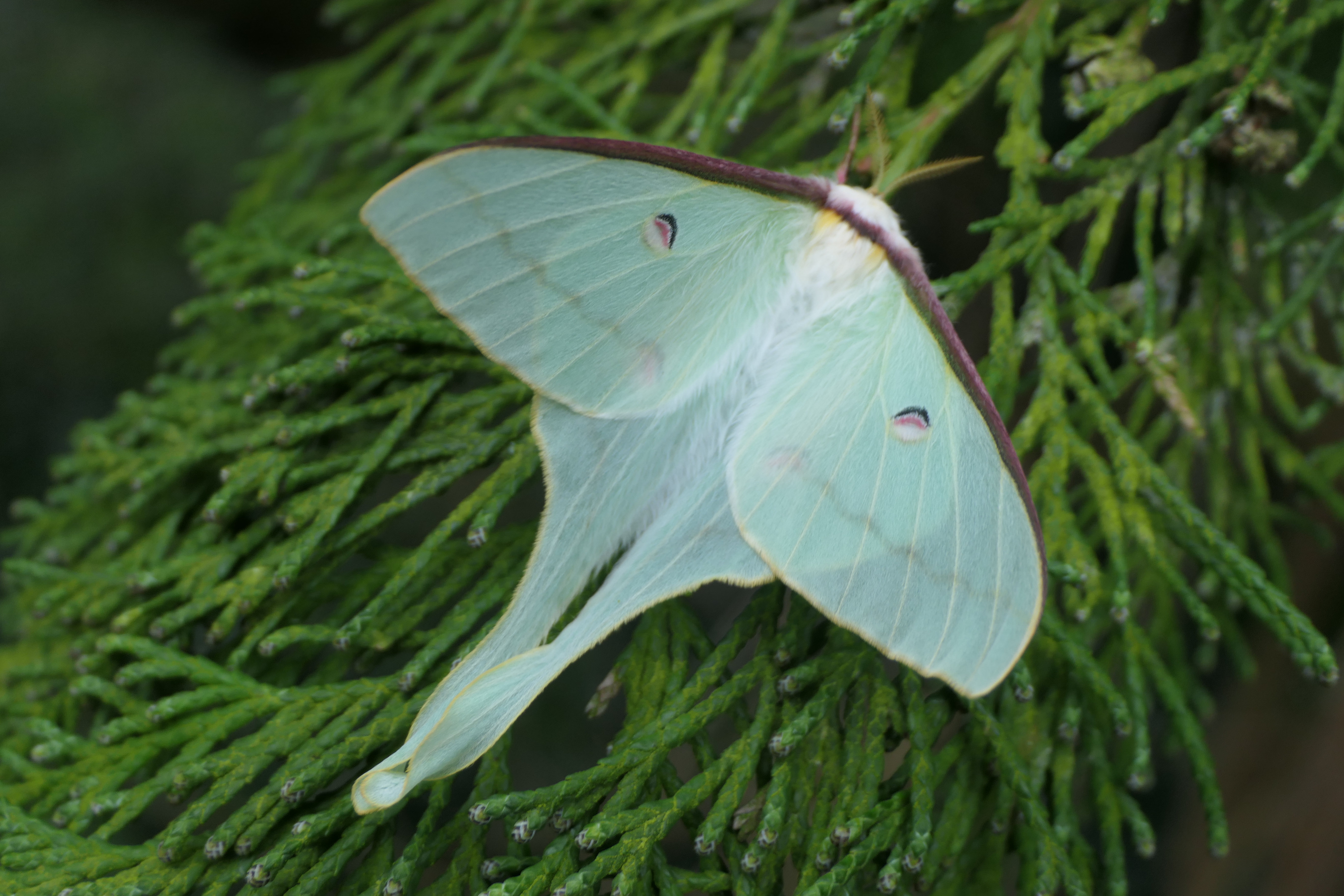
Actias neidhoeferi is one of the smallest species of moon moth I have personally seen. Females are slightly larger than males. In rare cases, hobbyists breed this species in captivity! And this page will include a breeding guide(!) for this rarity. It is one of the more interesting, challenging and elusive species that is very hard to obtain.

It is not just the adults that make this species special; the larvae are special too! The small but colorful caterpillars of Actias neidhoeferi look stunning.
My observations are as follows: Actias neidhoeferi is a somewhat (facultatively) cold-adapted species, but cold temperatures do not appear to be a hard biological requirement. In captivity, I reared three (3) broods of the species in one year on room temperature throughout summer and spring (18C-25C) and they thrived. In the wild, due to the high altitude, the habitat can be cold; but the flight time is something interesting. There are records of moths in nearly all months of the year, but there is a large peak flight with one main brood (April-June) and a partial second brood (July-September) that account for most of the individuals of this species. However, outside of these two main peak-flights, smaller numbers of moths are reported in different months of the year as well. The coldest months of the year do have the least amount of observations; there seem to be more or less no observations in October and November. I did find a small amount of records of moths found in December, January and February. This may suggest that the populations do generally follow seasonal patterns, but also that this cold-hardy species is perhaps capable of breeding at nearly all times of the year minus perhaps the two coldest months in lower (background) densities, while the majority (but not all) of the population follows the warmer times of the year. Either that, or some people simply add the wrong date to their moth observations! Perhaps more research is warranted in this area. – My guess is that the species is capable of dealing with both low temperatures, and higher summer temperatures. As a high altitude species in a subtropical country, they logically have to deal with both warmth and colder temperatures. I can also confirm that in captivity, the adults were active, and mated in cooler temperatures (13C) outdoors in autumn.
Please note that many of the things I formulated on this post are conjecture; I am merely an observant and overenthusiastic insect breeder that tries to extrapolate their behaviour in captivity to apply it to the natural situation. But my observations are not gospel! To verify some of these things, studying them more in the natural habitat (as opposed to what they do in captivity) is warranted.
- Difficulty rating: Moderate – In my opinion they are harder than the average moon moth, but not extremely difficult. Creating the right environment for them (cool, humid) is half the challenge and so is finding the right host plant. I managed to breed three (3) generations in one year with very little losses, after struggling to get the first brood established.
- Rearing difficulty: 6.5/10 (From egg to pupa)
- Pairing difficulty: 3/10 (Achieving copulations)
- Host plants: In nature, the host plants are Taiwan fir (Abies kawakamii) and Taiwan spruce (Picea morrisonicola). In captivity, it is recommended to give them fir or spruce for this reason. In captivity, it can also be reared on Larix (larch), and hemlock (Tsuga). Do not give them pine (Pinus); larvae seem to develop poorly on it.
- Natural range: Taiwan (Miaoli County, East Coast National Scenic Area; -Nantou County in general, Yilan County, Taipingshan National Forest area, Hualien Country in the mountains east of Taroko National Park – and generally in the mountainous regions of central Taiwan; also present but more rare in the South e.g parts of Taitung Country such as Xiangyang National Forest Recreation Area) (1900m-2600m+) coniferous tree forest
- Polyphagous: Somewhat; but only restricted to coniferous trees. However, it can even feed on non native species of conifers.
- Generations: The flight time is something interesting. There are records of moths in nearly all months of the year, but there is a large peak flight with one main brood (April-June) and a partial second brood (July-September). The coldest months of the year do have the least amount of observations but suprisingly, they do have some. I did find records of some adults in December and February. This may suggest that the populations do generally follow seasonal patterns, but also that this cold-hardy species is perhaps capable of breeding at nearly all times of the year in lower (background) densities, while the majority (but not all) of the population follows the warmer times of the year. Perhaps more research is warranted.
- Family: Saturniidae (silkmoths)
- Pupation: Silk cocoon
- Prefered climate: Moderate to cooler temperatures, and higher humidity (it is a high altitude mountain species).
- Wingspan: 60m-105mm (One of the smaller moon moths. Size varies a bit between individuals and broods. Females are often a little bit bigger than males. Due to their often small size it is also dubbed the ‘Mini moon moth’).
- Binomial name: Actias neidhoeferi (Ong & Yu, 1968)
- Special notes: Do not use Pinus (pine tree) to rear this species. Some sources mention it as a host plant, but I’ve only had bad results. This is confusing because most pine feeding Actias species are specialised in using Pinus as a host plant, but Actias neidhoeferi is one of the exceptions! They evolved to feed on Picea and Abies instead and seem to struggle when provided Pinus. — The best to use are Abies (fir) and Picea (spruce). They’ve also been reared on Tsuga (hemlock) and Larix (larch). Interestingly they seem to feed on most conifers with acceptable results, or atleast a broad variety of them, but the exception seems to be that they don’t grow well on pine tree (Pinus) at all. – This species is also very pricey. One dead, preserved female can sell for over 180$ to the right collector! Not that I would ever promote breeding insects for purely for money (it’s a bit questionable!) but if done right and ethically it can be lucrative.
If you’re reading this page because you’re about to breed this species, consider yourself lucky! Actias neidhoeferi is one of the more rare moon moths one can obtain in captivity! Only a few people world wide have managed to do it. In my opinion they are not super difficult to breed, but they are trickier than the average Actias species (to be honest, most Actias species are easy; the conifer feeders tend to be the trickier ones).
Many of the basic rules apply. Eggs can be hatched in plastic containers; such as petri dishes. Expect small black babies after 10 to 15 days. It is wise to keep the container humid and mist the eggs with water; but be conservative (the eggs and small larvae can drown in big droplets). Use fine misting.
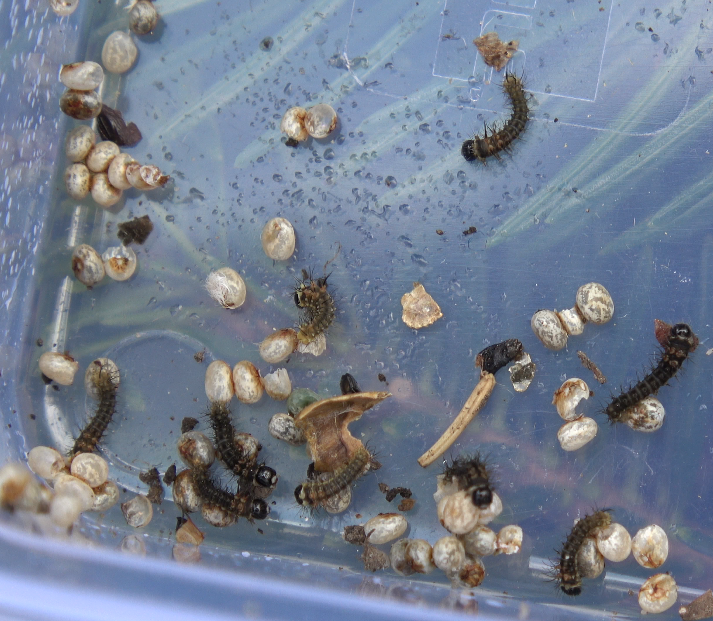
From egg to cocoon, this species can be reared in plastic boxes. They tolerate higher humidity, with virtually no airflow or ventilation at all. To regulate humidity, a thick layer of absorbant paper towels is enough. The species likes humid but not wet conditions. In captivity, it is recommended to give them Picea or Abies but they can also be reared on Abies (fir), Larix (larch), and hemlock (Tsuga).


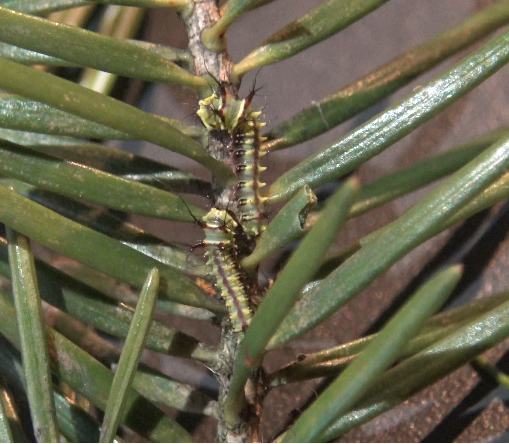
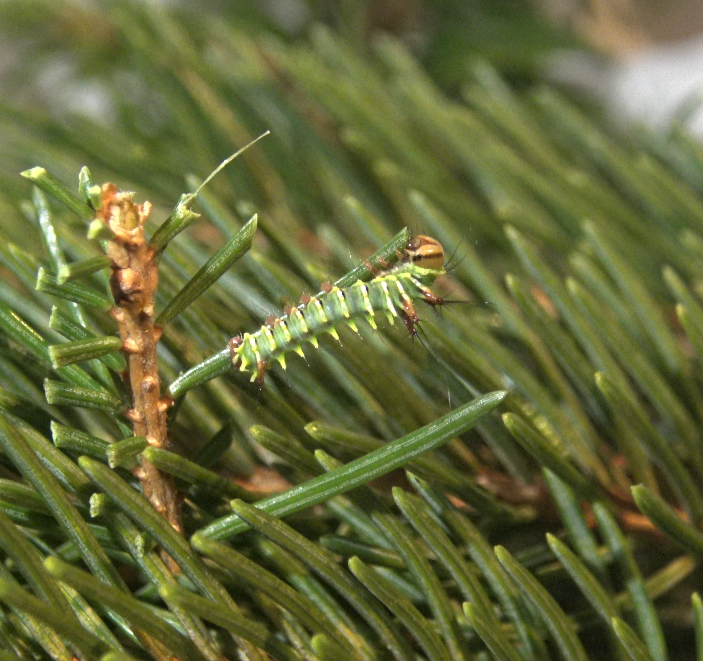
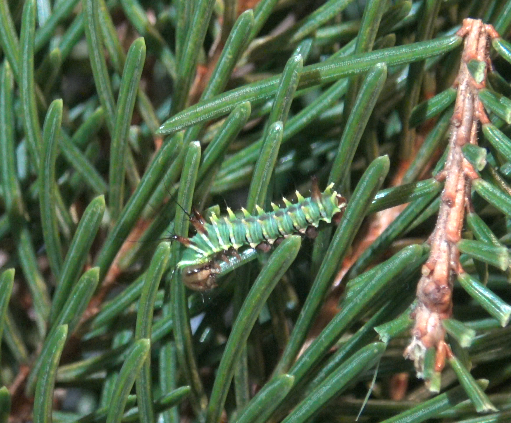
Larvae are solitary. While they seem to tolerate higher densities, considering this is a valuable and rare species, it’s wise not to push it. I reared many of them in Sunware plastic storage boxes (only 4 larvae per container); but I’ve also managed to rear one larger group of 23 individuals in a bigger box and it went pretty well.
The first instar is totally black/grey. The second instar is green, with a brown back stripe, and brown streak running along their flank, connecting the spiracles. The third instar is green, with a brown head capsule, a brown anal horn, and elongated, brown thorarical spines. The fourth instar and fifth instar have amazing, golden metallic structures.

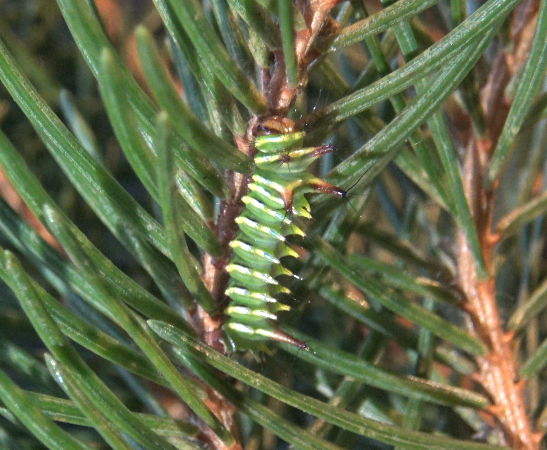
In terms of difficulty, the species Actias neidhoeferi can either be very easy or very frustrating. It all comes down to creating just the right micro-environment for them. If you really nail the conditions and get them exactly right they become quite easy to keep alive.
The easy part: larvae can be reared in a very similar setup all their life! Usually early instars and late instars of moths have different demands. But each instar of Actias neidhoeferi can be kept in exactly the same boxes and same conditions, from hatchling to pupae – so long as the boxes are big enough. It is also a comparatively tiny species and they don’t need as much space or food as compared to other Actias species. Mature larvae will be about 3.5cm-4cm in length. I’ve managed to rear several broods with comparatively little effort, and from the moment the eggs hatched all I had to do was clean the containers and provide fresh food consistently, without changing the setup until they all cocooned!
The hard: to strike the right balance between too dry and too humid. This is the main challenge when it comes to coniferous-feeding moon moths species. Many of them are highland species that have adapted to higher humidity and generally cooler temperatures. When reared indoors, they can find it too dry or too warm in some instances. However, humidity by itself also creates problems of its own: too much humidity tends to promote the growth of micro organisms (bacteria) and fungi that tend to be harmful pathogens, and will cause your larvae to become sick or infected. Too dry? Your larvae will struggle to feed and grow. Too humid? Your larvae will succumb to disease. Avoid extremes. Avoid ‘wetness’. I reared mine in completely airtight boxes with food plant cuttings, with a generous layer of paper towels to absorb excess moisture – and I used a plant sprayer to give them a very fine misting for slight humidity. Conditions in captivity fluctuated, but an average gentle 18C-21C and 70%-80% RH should be acceptable.


In captivity, to my suprise, the species appears to be continuously brooded. If kept warm, the cocoons and pupae will simply develop and produce moths in 2-3 months time. In the wild, the species seems to be more seasonal with a possibly facultative diapause. I was able to find records of the moths in nearly all months of the year(!) in Taiwan. However, they are more common in certain months, and rare in other seasons. There appears to be a ‘peak’ flight with one main brood (April-June) and a partial second brood (July-September). This suggests that cool temperatures probably suppress the developent of the pupae to some degree, but that if temperatures are warm enough, they can opportunistically develop into moths at any time of the year. The cocoons like humidity and seemed to be fine on room temperature (21C). – The cocoons can probably be diapaused when kept at lower temperatures. For this one could store them outdoors in winter or in a refridgerator, or a cool basement.


The moths of Actias neidhoeferi are easy to pair in captivity, and tolerate both warmer and cold temperatures. They are very eager to mate. In many cases, the males stay close to the female until the next morning after mating (but not always, some males abandon her after the deed). They generally have a lifespan of 7 to 14 days. In order to pair them, keep them in pop-up cages made for insects (or net cages). – Males are easy to tell apart, they have more sharp, ‘falcate’ wings and larger feathered antennae. Females are more plump, have a bigger wing surface area and look more ‘diamond’ shaped, and have much thinner antennae.
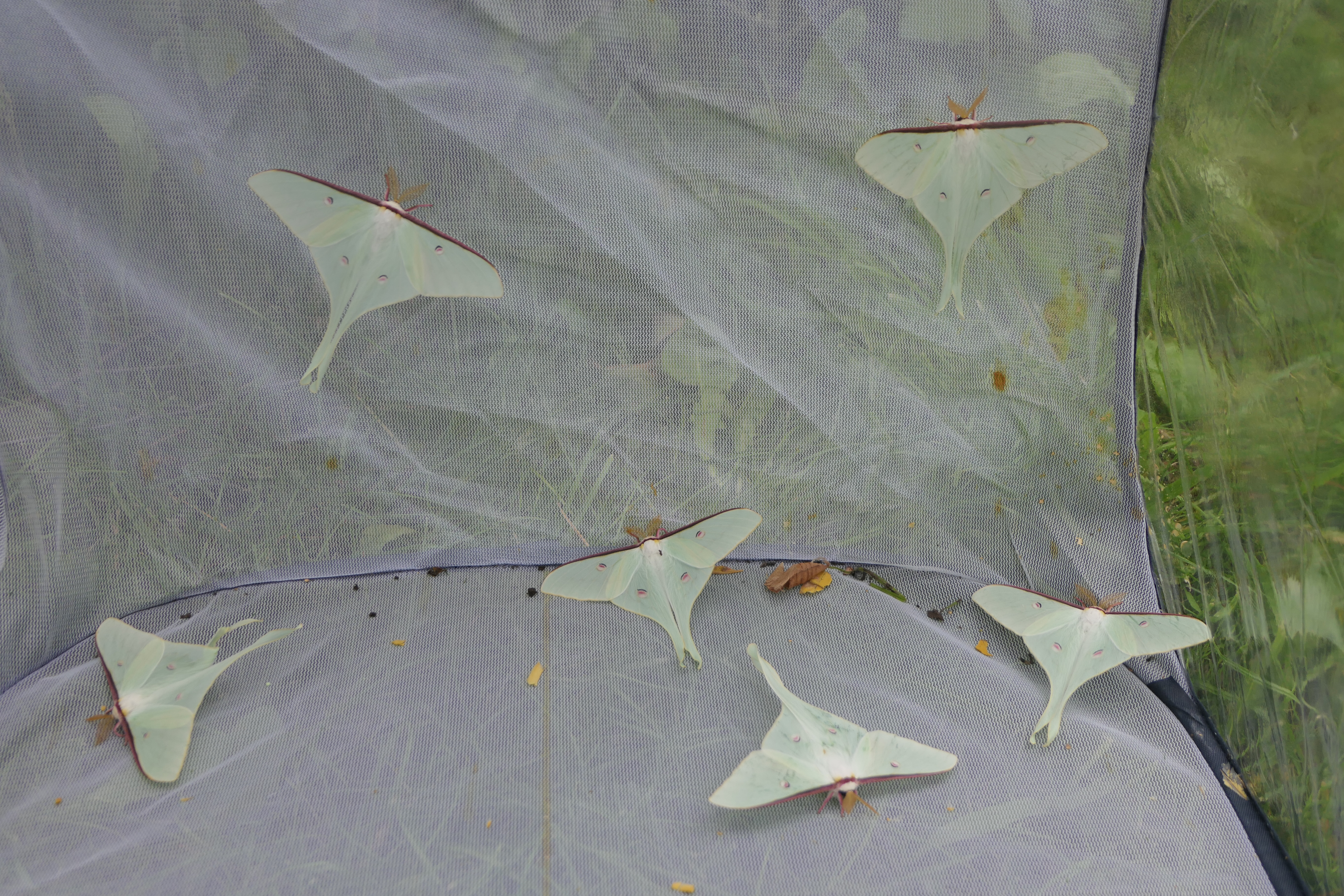


Females of this species are quite passive and if left undisturbed/unbothered they don’t seem to fly or move much at all, atleast until a male has visited them. After she has mated, females will relocate to find a good spot to lay eggs. They tend to lay most of their eggs in the span of 1-3 nights and then they die. If you did it right, you’ll have many fertile eggs! The male is more nervous. The moths can mate in rather low temperatures, which is to be expected given what we know about their ecology. I have personally mated males and females outdoors in temperatures down to 14C, and I’m sure they might tolerate even cooler temperatures.
The smallest species of moon moths tend to be from the Actias felicis-complex (this also includes Actias felicis, uljanae, rasa, kongjiaria, shaanxiana and a few brechiebrechiemeisteriemeisteriebrechmeister species that they named after themselves again of course). Actias neidhoeferi is also included in this species complex; and as far as I am aware all the species in this group feed on conifers as larvae.
Thank you for reading my caresheet. This website has the life cycles of many rare moon moths! Consider contributing to education and (moon moth) research if this article was useful to you. This website is crowdfunded and the contributions of many readers make it possible for me to document so many moth life cycles! Additionally, if you live in Taiwan and have additional notes, observations or information then please contact me! email: bart.coppens@hotmail.com
Overall, Actias neidhoeferi is not a ‘super’ difficult species to breed, but basic experience with Saturniidae is warranted. The species does come with some unique challenges.
A special thanks to readers! Making this website sure was a big challenge; it is a massive investment of my time and resources. But thanks to you, my dear viewers and readers, it was made possible. Thank you to everyone who donated via PayPal or Patreon; or those who were simply kind and loyal enough to share this website with others, or to come back over the years to read and study the materials provided here. Obtaining, rearing, studying, photographing and writing about these exquisite moth species, while it’s a massive privilege, is also not something I can sustain doing alone. It is only because of you that I have the free time to slowly renovate and cannibalize older parts of the website, modernize them and keep them up-to date. Soon this website will have close to a thousand species pages or more, all written and produced by me; but I am not an ‘one-man-army’, because you my beautiful community, have backed me up all these years, and built me up in ways I could not imagine. Thank you for reading, sharing and being here today! This website will only grow bigger. – Usually I do not mention such things in the middle of an article, but Actias neidhoeferi is perhaps the most rare and special species I have reared in my career (subjective, but it feels like it to me); so perhaps it is worth mentioning here only on this page.
Thank you for reading my article. This is the end of this page. Below you will find some useful links to help you navigate my website better or help you find more information that you need about moths and butterflies.
Dear reader – thank you very much for visiting! Your readership is much appreciated. Are you perhaps…. (see below!)
- Not done browsing yet? Then click here to return to the homepage (HOMEPAGE)
- Looking for a specific species? Then click here to see the full species list (FULL SPECIES LIST)
- Looking for general (breeding)guides and information? Then click here to see the general information (GENERAL INFORMATION)
- Interested in a certain family? Then click here to see all featured Lepidoptera families (FAMILIES)
Citations: Coppens, B. (2025); Written by Bart Coppens; based on a real life breeding experience [for citations in literature and publications]
Was this information helpful to you? Then please consider contributing here (more information) to keep this information free and support the future of this website. This website is completely free to use, and crowdfunded. Contributions can be made via paypal, patreon, and several other ways.
All the funds I raise online will be invested in the website; in the form of new caresheets, but also rewriting and updating the old caresheets (some are scheduled to be rewritten), my educational websites, Youtube, breeding projects, the study of moths andconservation programs.
Donate button (Liberapay; credit card and VISA accepted)

Donate button (PayPal)
Become a member of my Patreon (Patreon)
Find me on YouTube
Find me on Instagram
Join the Discord server: Click here
Join the Whatsapp server: Click here
Facebook: Click here
Actias neidhoeferi is so seldomly observed or studied that entomologists have only managed to document and publish its full life cycle for the first time in 2013, which is not only relatively recent but also 45 years after the species was descibed to science; but today in 2024, entomologist Bart Coppens has studied and revealed the life cycle a second time in more detail! Thanks for reading.
 Welcome, visitor!